
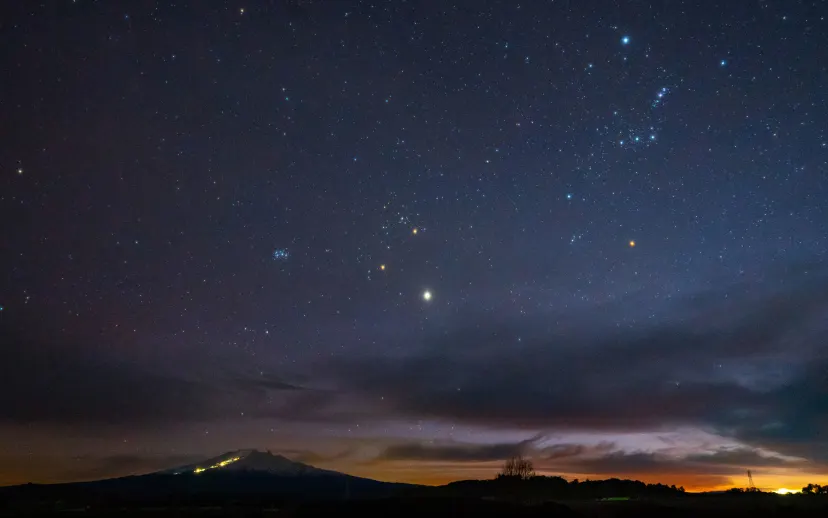
Source: RNZ Pacific
As conflicts and division dominate news headlines around the world, Professor Rangi Mātāmua (Tūhoe), said Matariki sends this message:
“Like the ocean connects us, the sky connects us, and we are connected to each other. And these are unusual, difficult times for many of us, we need each other more than we probably understand.
“We are all related, we come from the same place, and we actually come from the stars.”
Matariki is the Māori name for the entire Pleiades cluster as well as its brightest star.
In New Zealand, the rising of the Matariki cluster in mid-winter marks the beginning of the new year for many iwi, for others, the star Pūanga or Rigel is the marker of the new year.
It has now been five years since Matariki became a public holiday in New Zealand – this year it fell on Friday, 10 July.
The theme for this year’s Matariki celebrations is ‘Matariki Herenga Waka – Matariki For Everyone’.
There are three elements to Matariki; remembering those who are no longer with us, celebrating who we are today, and then looking to the future.
But what does Matariki mean to the rest of the Pacific?
For the chief advisor Mātauranga Matariki, Matariki has always been bigger than New Zealand.
Professor Mātāmua said the star cluster has connected Pacific people long before modern political borders existed.
“Matariki is found right throughout Polynesia, right throughout the Pacific.
“Those group of stars are the oldest, best recorded group of stars in human history, and many celebrations from around the world are connected to the visibility of those stars.”
Although New Zealand’s Matariki holiday has attracted international attention as a unique public holiday, Mātāmua is quick to point out that Matariki does not belong to any one nation.
He credits cultural leaders in Hawaii for inspiring many aspects of New Zealands current traditions.
“But it’d be wrong to think that it belongs to Aotearoa.
“In fact, much of the ceremony that we enact today, we got the courage to do that by going and observing our relations in Hawai’i, and when they celebrate Makahiki.
“In fact, what occurred and became a holiday, much of its origin is is back into our relations across Polynesia.”
Rather than encouraging Pacific nations to copy New Zealand’s approach, Mātāmua believes Pacific neighbours should rediscover their own stories and traditions.
“Because the diversity in our culture is not a weakness, it’s a strength, and it gives the beautiful flavours and colours, and the principles are the same, about people gathering and feasting and celebrating in the new year, but the way that it’s done is slightly different, and that gives it a richness that connects people to that place.”
Mātāmua has travelled all across the Pacific, helping communities strengthen their own Matariki traditions.
He said the island’s individual Matariki traditions began to fade away as colonisation, Christianity and political borders shifted the regions dynamics.
But he is proud to see a growing interest in Matariki across the Pacific, as communities revive their own celebrations.
Last November, he was in Tahiti where they marked Matariki with an official public holiday for the very first time.
“One of the wonderful things that I learned from from Tahiti is the element of celebration.
“They have the ceremony but they came together to celebrate! Dancing, singing, music, feasting, spending time together.”
He says Tahiti reminded him that while traditional ceremonies and reflecting on the past is important, celebration is equally essential.
“People say Matariki is a sombre time where we just remember the dead, we stay tapu, but no, no, that’s not the case. In fact, quite the opposite, we remember the dead for that early morning rise, and then from there on we celebrate.”
While New Zealand and Tahiti are the only countries that mark Matariki with a public holiday, Mātāmua shared that there is movement across the region and he is dreaming of the day when the whole Pacific officially commemorates Matariki.
For Mātāmua, perhaps the greatest lesson Matariki offers today is one of unity.
He points to the stars themselves, each star has its own identity, representing different parts of the natural world and different responsibilities.
But every year in the morning of Matariki they rise together as one cluster.
“Te Matariki hunga nui means the people of Matariki – we are a cluster, even though we’re different, we have all of these diverse elements to us, we come together as a family and shine upon you and bring you wellbeing, and we’re meant to respond as like; gather together and rise as a whanau, as a collective.”
To find Matariki, look to the eastern horizon before the sun rises and find three bright stars in a line – this is Orion’s belt, known to Māori as ‘Tautoru’.
Next, trace a line to the left of Tautoru until you come to the bright orange star Taumata-kuku – part of a group of stars in the shape of a pyramid. From there, continue to the left until you find a small cluster of stars. That’s Matariki.