
Source: RNZ Pacific
Pacific Island countries, which primarily rely on oil to meet their energy needs, are starting to feel the effects of the United States and Israel’s war on Iran.
The conflict in the Middle East is affecting countries around the world, but Pacific Islands – isolated geographically – are particularly vulnerable as they do not have domestic oil production or large storage capacity to cushion them form the effects of the geopolitical situation.
Clean energy researchers say the Middle East fuel crisis underscores the need for Pacific countries to adopt renewable energy.
A new report from Zero Carbon Analytics stated around 80 percent of Pacific Islands countries’ energy relies on imported oil products.
The report noted that the Cook Islands, Fiji, Nauru, Marshall Islands, Samoa, Tuvalu and Vanuatu have all pledged to achieve 100 percent renewable electricity by 2035; while Tonga and Solomon Islands have set a target of 70 percent renewable electricity by 2030, and complete renewable generation by 2050.
Zero Carbon Analytics said meeting these targets and moving away from reliance on imported energy would provide a significant buffer against volatility in international fossil fuel markets.
But it also said progress has been slow in much of the region.
Renewable power made up almost 50 percent of the world’s electricity capacity last year after a record increase in solar installations, data from the International Renewable Energy Agency shared exclusively with Reuters shows.
Fuel prices in the Pacific
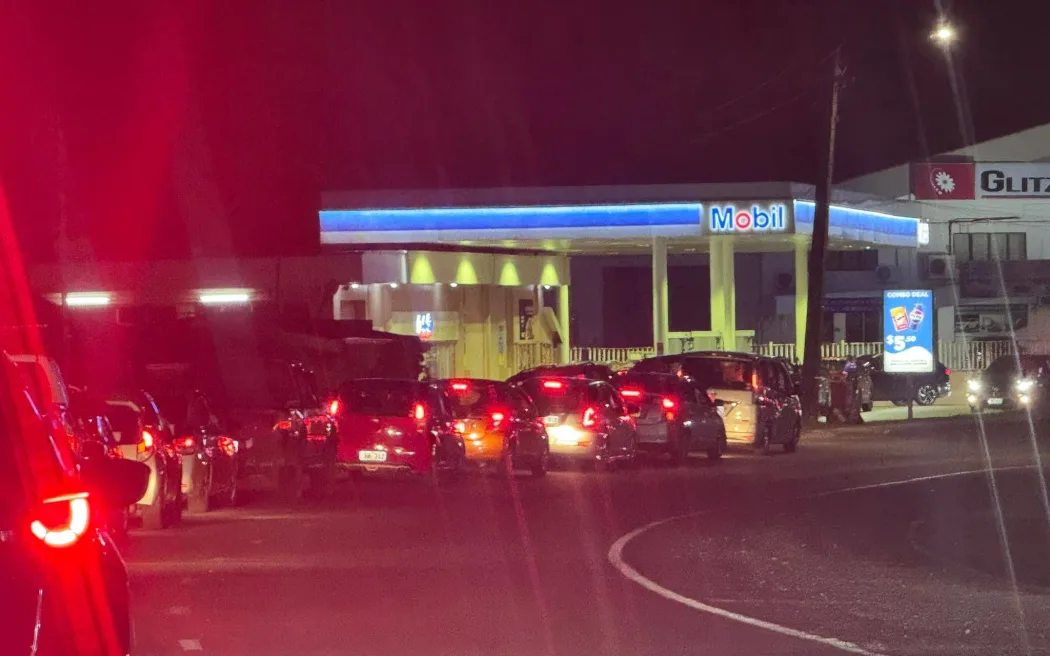
Commuters and motorists in parts of Fiji lined up at petrol stations on Tuesday night to fuel up, after the country’s fair trade regulator confirmed a nationwide fuel price increase due to the war in the Middle East.
The Fijian Competition and Consumer Commission (FCCC) released revised fuel prices for April late on Tuesday, with motor spirit (unleaded) and premix increasing by nearly 50 cents (NZ$0.38), while diesel increasing by almost 80 cents (NZ$0.61).
The price spike comes just two weeks after Prime Minister Sitiveni Rabuka assured the public that there would be no rise in fuel costs.
Samoa‘s latest fuel prices show a slight increase, but the Government said this is not a result of the conflict in the Middle East.
“Samoa’s April retail prices are based on the cargo uplifted in February from Singapore, which was discharged in Apia on 25 March.
“The increase in prices reflects market conditions prior to the outbreak of the Iran/USA/Israeli conflict.”
For April, petrol went up from $2.82 to $2.85 and diesel from $2.99 to $3.09. Kerosene has risen from $2.63 to $2.70
Samoa’s next cargo was due to load in late March or early April for delivery in early May.
On 26 March, the Government said following the 24 March fuel offload, “national fuel stocks are expected to remain at comfortable levels, with petrol and diesel projected to cover approximately 50-60 days, and jet fuel/kerosene up to 80 days”.
High fuel prices are hitting the Northern Mariana Islands, and Governor David Apatang directed all Executive Branch departments, offices, and agencies to implement revised austerity measures, beginning last week.
CNMI’s delegate to the US Congress Kimberlyn King-Hinds wrote a letter to US Energy Secretary Chris Wright, saying fuel prices were rising to unsustainable levels across all three inhabited islands.
Vanuatu‘s Utilities Regulatory Authority said the country’s fuel supply is sourced through Singapore, where prices are largely influenced by Dubai crude oil.
But the authority advised electricity customers in Port Vila and Luganville that price increases were forecast for April, with Vila rising by 12.07 percent and Luganville by 5.31 percent.
“The difference is due to generation sources – Port Vila relies more on diesel, while Luganville benefits from more stable hydro (renewable) energy.”
Electricity prices in both Port Vila and Luganville are assumed to decrease by one percent for the month of May.
In Palau, the Island Times reported president Surangel Whipps Jr has expressed support for restoring household power subsidies cut from the financial year 2026 budget, citing the ongoing global fuel crisis and its impact on local energy costs.
Meanwhile, Nauru’s Pesident David Adeang has called for calm amidst fuel concerns connected to the Middle East war.
The government said it has already implemented all necessary measures to secure sufficient fuel reserves for Nauru.
In his parliament statement last week, Adeang told the public to act responsibly and to use fuel and electricity wisely.
The government said the country’s fuel supplier, Vital Energy, issued a statement last month advising it is closely monitoring international fuel markets.
It said prolonged disruption could affect fuel supply chains, but said there were no issues with the supply of petroleum products to Nauru.
In the Marshall Islands, a 90-day state of economic emergency has been declared.
According to the Government, the conflict’s impact in causing an increase in fuel prices ultimately affects all other commodities imported into the country.
Tonga‘s government has reassured the public that the fuel situation in the kingdom remains stable, for now.
Government leaders provided an update on 27 March on the challenges facing the country with regards to the fuel supply.
Prime Minister Lord Fakafanua said Tonga still has sufficient diesel reserves to maintain electricity supply for approximately three months, but that prolonged global disruptions could create serious challenges by mid-year.
Lord Fakafanua said if it continues through April, May, and into June and July, they will be in a critical and dangerous situation.
A week ago, the prime minister warned people against panic fuel buying.
As of March 30, fuel stocks in the Cook Islands dropped to just 20 days – less than half of full capacity.
Local suppliers were confident that current stock was sufficient to last until the next shipment in early April – provided there is “no panic buying” – but they have warned of looming price increases.
The Solomon Islands Government said last week the country held between 40 to 50 days of fuel supply in-country, and when factoring in fuel shipments at sea, total available supply increases to an estimated 50 to 90 days.
Papua New Guinea‘s government said it has enough fuel to meet national demand for the next three months, the ABC reported.
The government of the Federated States of Micronesia said on 31 March it wished to assure state governments, businesses, and the public that fuel supply in the country remained secure “at this early stage”, and “there are currently no issues with the supply of petroleum products to the FSM”.
“Reports from around the region indicate escalating oil prices and oil shortages, and government entities, businesses, and the public are urged not to engage in panic buying or hoarding.
“There is sufficient product to meet requirements based on past purchasing practices and demand.”
Niue‘s prime minister said in mid-March there was no immediate risk of fuel shortage, but the Government said prolonged increases in global oil prices or disruptions to shipping schedules may affect Niue.