
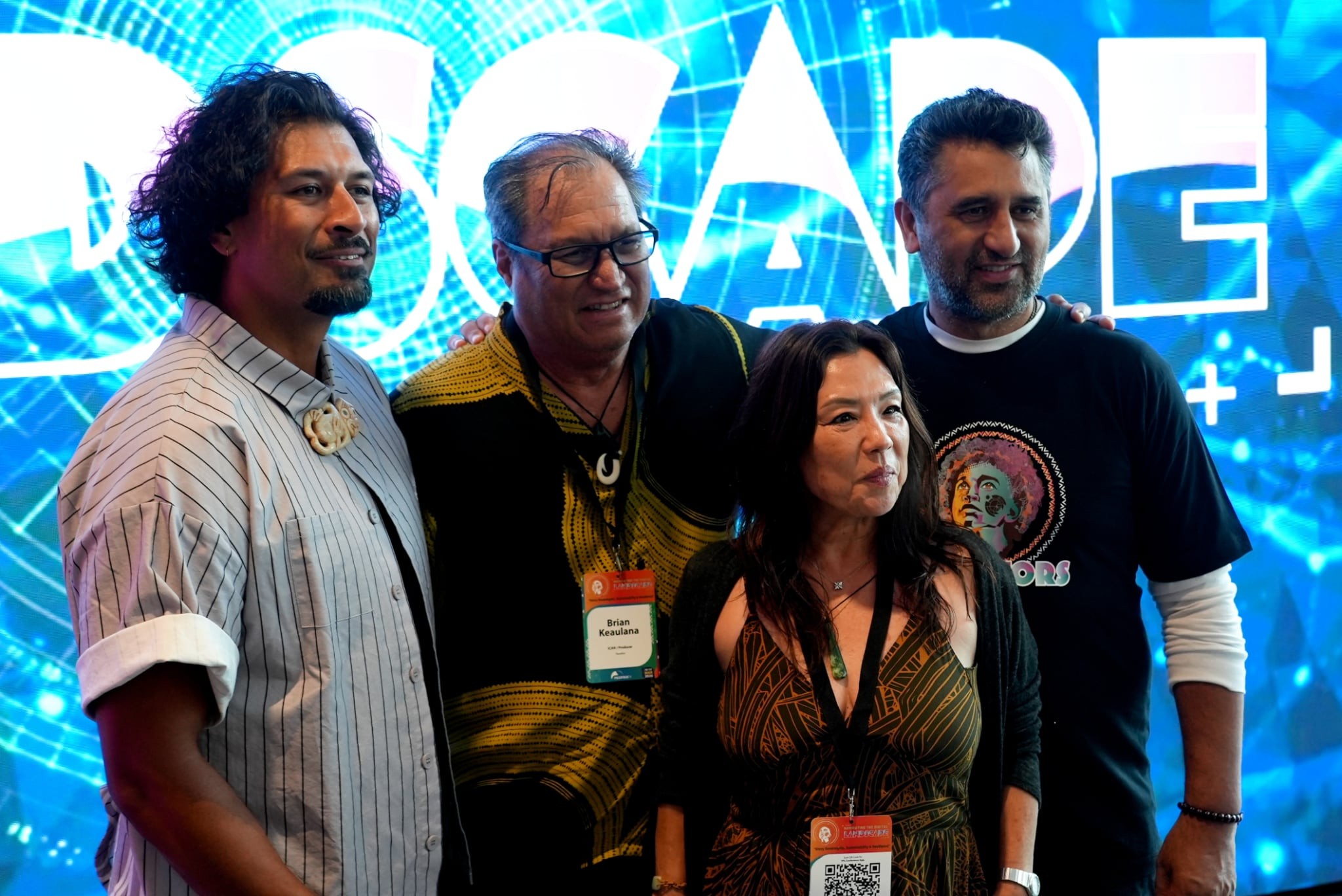

The ocean speaks the oldest language in Polynesia, says legendary Hawaiian waterman and Chief of War producer Brian Keaulana.
“Only some people can understand it … learning this ancient knowledge and then learning the science side of it in school augmented that information and the need to pass it on—and not be a gatekeeper,” says Brian during the recent Navigating the Digital Landscape conference in Auckland, New Zealand.
Destined to be a waterman
Growing up in Mākaha, Oahu, as the son of Richard “Buffalo” Keaulana, a renown surfer and one of the original navigators of the Hōkūleʻa, Brian’s destiny as a waterman—and a navigator of cultural spaces—was written before he was born.
Brian followed in his father’s footsteps, surfing professionally and traveling the world, before returning to Hawai’i where he became a professional lifeguard, and pioneered the use of jet-skis for water rescue and big-wave surfing.
His waterman and lifesaving skills first opened doors to the film industry 38 years ago, Brian says.
“I started off in surfing…then I got into acting first, then modelling, and then stunt work.
“That stunt work led me to stunt coordinating, directing, and producing.”
Brian has worked on a host of hit films and shows, from Baywatch to Waterworld to Magnum P.I., Hawaii Five-O, and Lost.
Lead with culture
Aside from his water skills, Brian offers something more invaluable—his traditional knowledge of Hawai’i and Kānaka Maoli.
The Keaulanas can trace their lineage back to King Kamehameha.
Most recently, Brian worked on Chief of War, the story of the unification of the Hawaiian Islands, filmed entirely in Ōlelo Hawaiʻi, and stars Jason Momoa, who also created the Apple TV series alongside Thomas Paʻa Sibbett.
Working as water unit director and producer, Brian played an integral role in ensuring the popular series “led with culture first,” collaborating with fellow producer Angie Laprete.
“The real success of this show was in developing everything in the pre-planning,” he says.
“I work backwards—I work from a place of success and ask, ‘How do we get there?’
“It was also about operating in a frame of mind of indigenous producing.
“That means rather than just getting permits, you get permission.
“You go to the elders of the people of that area and ask permission first before you go and get the proper permits.
“It’s about hiring the local indigenous people from that area and getting the right professional consultants in the art of anything in the Hawaiian culture—and that includes the ‘ōlelo as well.
“That was the true success.”
Return to New Zealand
Brian is no stranger to the Land of the Long White Cloud, with the filming of Chief of War taking place in both New Zealand and Hawai’i.
When Brian and Angie were asked to share insights at the conference hosted by Pacific Cooperation Broadcasting Limited (PCBL) in Auckland, they both jumped at the chance.
The conference targeted Pacific broadcaster CEOs but also incorporated a United States Department of State Young Pacific Leaders (YPL) workshop, featuring 30 content creators and media representatives, from 20 Pacific countries.
Brian says the “navigating” part of the conference has resonated with him.
“My father, Buffalo, was one of the navigators for Hōkūleʻa and being in the film industry is a lot about navigating that platform.
“You deal with great powers that you have to manage, and it’s about having the right people on your crew and seeing the right visions, but I think along the way, it’s about the value system of how we operate amongst ourselves…not having other people’s identity pushed on top of us.
“How do we write from the inside out? How do we work within the space that our ancestors have given us?
“That’s the true power. If we operate from there, we’re already succeeding.”
People’s willingness to collaborate and learn from each other, to stay relevant and sustainable and to own their own stories has impressed the producer.
“I want this to exist in Hawai’i too, because I see such great opportunity and passion here—a village mentality.
“You look at everybody and see so much going on in a positive way.
“It’s not just about patting themselves on the back; it’s about attainable missions and seeing the fruits of their goals.
“When I look into the crowd, I see the future Taika Waititis, Cliff Curtises, or Jason Momoas. You can see the potential.”
Navigating the space
With his years of experience navigating a film industry, Brian encourages the YPL cohort and future generation of storytellers to breathe, take their time and have patience when it comes to their craft.
“A lot of it is like learning from the ocean: it’s about timing, patience, and knowing the waters and the atmosphere.
“Also teach people your values.”
For the movies he works on now, he issues a Kuleana contract—a contract of responsibility.
“Through our culture, there are certain words we use and have grown up with,” he says.
“I use those to educate the people coming from the Mainland, so they understand who we are as a people and the meanings behind those words.
“They learn it, share it, and teach it.
“In Hollywood filmmaking, leaders are often responsible but never accountable—there’s a blaming factor.
“But in Polynesian culture, being responsible is being accountable for the people you surround yourself with—it is about taking responsibility for family and friends and giving them the opportunity to learn.
“Don’t throw them under the bus and use those mistakes as lessons, because if you just treat them as mistakes, they’ll come back again.
“If you turn them into a lesson, that seed will grow into something powerful for all of us.”
Visit the Young Pacific Leaders website for more information about the US Department of State program.