
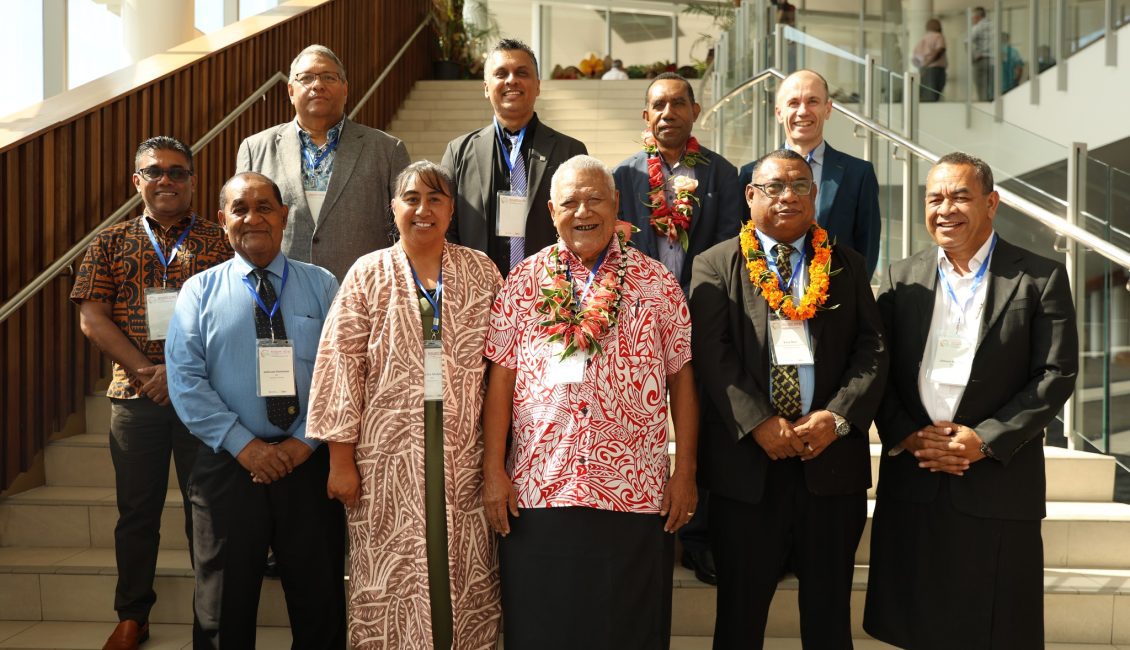
Natasha Meleisea with fellow Pacific media leaders at the 2026 Pacific Media Partnership Conference, in Port Moresby. Photo credit: ABU / Facebook.
By Michelle Curran
Executive Communications Manager, Pasifika TV/PCBL
Vulnerable island communities in the region will stay connected and informed in times of emergency thanks to Pacific Cooperation Broadcasting Limited’s (PCBL) Emergency Response Unit for the Pacific.
The unit is being launched by PCBL, which is funded Ministry of Foreign Affairs and Trade’s (MFAT) to uplift and empower Pacific media, in collaboration with the New Zealand Defence Force, Kordia and MFAT Humanitarian team.
Speaking at the 2026 Pacific Media Partnership Conference (PMPC) in Port Moresby, Papua New Guinea this week, Chief Executive of PCBL Natasha Meleisea says the main aim of the unit is to ensure broadcast continuity in vulnerable Pacific Island countries, following natural disasters.
“We heard the calls from our Pacific broadcasters following the Hunga Tonga–Hunga Haʻapai volcanic eruption in 2022 and the 2024 earthquake in Vanuatu and knew PCBL had to do something to help them with disaster preparedness,” Natasha says.
“Both our broadcasters in Vanuatu and Tonga struggled to convey critical messages to their own communities immediately following the natural disasters, due to the damage sustained.
“Broadcast continuity mitigates any risk of misinformation or disinformation filling the void when a national broadcaster is unable to perform their obligations as a trusted information source.
“Domestically it allows government, Civil Defence and NGO messaging to keep impacted populations informed, while internationally it keeps aid agencies and governments across the scale of a disaster, while simultaneously keeping global news agencies and the diaspora updated and informed.”
The announcement of the Emergency Response Unit launch comes exactly one year after the 2025 PMPC in Suva, where broadcasters from Vanuatu, Samoa, Tonga, Fiji, Papua New Guinea, Solomon Islands, New Caledonia and Tuvalu discussed at length how a regional mobile emergency response system would be useful for the Pacific.
Natasha says it was agreed this would be a significant resource for the region to ensure restoration of broadcast transmission and continuity of news and public service information in a disaster.
“It also became apparent there is a strategic opportunity for New Zealand to lead on this as others, are currently unable to address this issue.”
A collaborative effort, the project is commissioned, designed, and built by Kordia New Zealand Broadcast Systems Integrators (SI) who have full oversight of this project.
The Emergency Response Mobile Broadcasting Transmission Unit – FM Radio will remain in New Zealand for regular testing and maintenance to ensure it is fully operational when deployed via NZDF, while PCBL and MFAT will coordinate the deployment of the emergency broadcast solution.
This project aligns with the overarching goal of PCBL, which is to leave not only Pacific media but the entire region, in a better place, Natasha adds.
Meanwhile, Pacific Connections Director at MFAT Felicity Bollen says broadcast continuity in a natural disaster has not been prioritised as part of first response by traditional aid donors such as New Zealand and Australia previously.
“Rather local broadcasters are expected to manage this themselves,” Felicity says.
“Strategically, this project is important as it, along with training, builds regional capability and cooperation towards disaster resilience and climate change throughout the Pacific.”
Initially, PCBL will provide one remote fly-away news production kit (REMI Kit) to ensure local news can be produced and international queries can be managed on the ground by a support crew of a broadcast engineer and news resource, who will be deployed along with the equipment.
The REMI kit complements the Kordia-designed mobile emergency response system – the Kordia solution will focus on establishing broadcast transmission and studio linking, while the REMI kit will focus on the local broadcaster having the capability of doing remote production of news bulletins and distribution of information in a compromised environment.
It provides redundancy capacity for affected broadcasters as it is a mobile disaster response solution.
These kits will be stored at New Zealand High Commission offices throughout the Pacific, including Vanuatu, Samoa and Tonga initially.
Delivery of the kits starts this month, with the PCBL team executing training while in-country.