
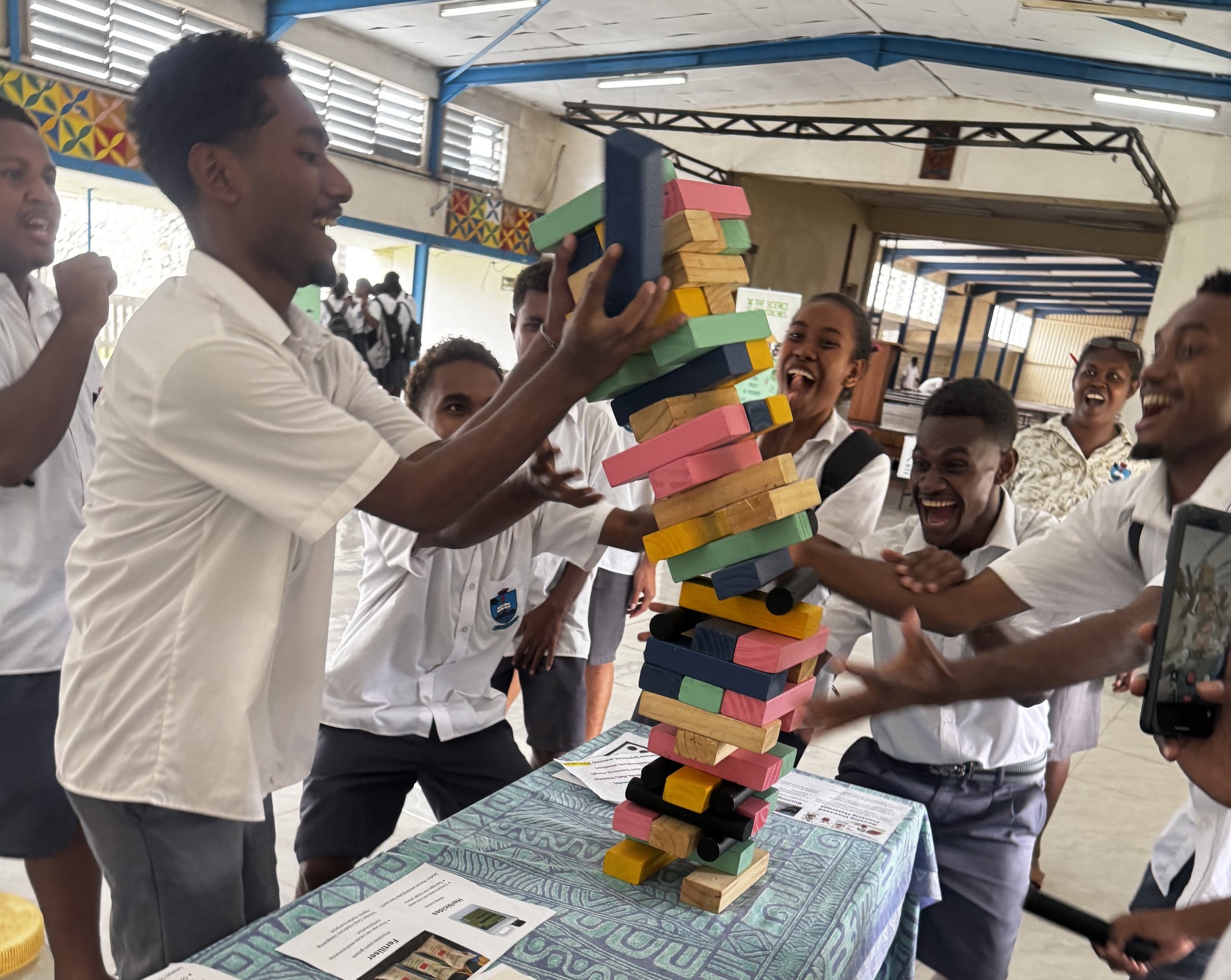
Source: University of Otago
Students in the Solomon Islands have recently undergone a range of science experiences after a three-person team led by Associate Professor Greg Walker University of Otago Ōtākou Whakaihu Waka School of Pharmacy and Pharmacology visited the Pacific country to deliver hands-on science engagement.
Greg says it was great to be able to spark a real interest and enthusiasm for science.
“We took two science showcases – effectively mini-science themed exhibitions with hands-on interactives, displays, and demonstrations,” he says.
“We’ve taken them to several Polynesian countries previously where they’ve been a hit, so it was nice to see they also worked well here in Melanesia.”
He adds very few schools in the Solomon Islands have any form of science labs, so get little in the way of first-hand STEM (Science, Technology, Engineering, Maths) experience.
“One school said their last visit by any external educator was in 2017 so they were hugely responsive which made it a really rewarding experience.”
Botanist, Dr Peter Heenan from the Bioeconomy Science Institute, and science engagement specialist Dr Craig Grant joined Greg on the tour with the Genomes – The Science of Life and the Science of Medicines | Te Mātauranga o te Rongoā science showcases.
Genomes – The Science of Life was developed by Genomics Aotearoa to help demystify what the field of genomics involves and highlight how new genomic-based technologies are being used to better understand and manage natural resources, biodiversity, and health.
Genomics Aotearoa Co-director, Professor Peter Dearden, notes the showcase introduces what DNA is and how it contains the information that on one hand makes us all so similar but also uniquely different.
Activities range from extracting DNA from fruit, to playing Biodiversity Jenga to understand the importance of biodiversity for healthy ecosystems.
Students will also have the chance to become DNA Detectives by using new environmental DNA (eDNA) tools to discover the full range of flora and fauna living in their local rivers and coastlines.
Science of Medicines was developed by Dr Karyn Maclennan from the Department of Public Health (Dunedin).
Using a waka and wayfinding framework, the exhibition takes students on a journey into the science of medicines.
Resources include Nature’s Medicine Chest where students can explore the diverse range of flora and fauna from which traditional and modern-day medicines were derived.
Another popular module, Meet and Beat the Microbes, highlights issues such as the importance of using medicines correctly to avoid issues such as antibiotic resistance, and how critical community immunity can be to combat infectious diseases.
The tour was supported by the Ministry of Foreign Affairs and Trade (MFAT).
“We’re delighted that MFAT are showing leadership with initiatives such as this new science engagement collaboration between New Zealand and the Solomon Islands,” Greg says.
During the visit the team connected with the Solomon Islands’ Ministry of Education and Human Resource Development (MEHRD) and the Solomon Islands National University (SINU).
“Both these organisations are actively trying to increase participation in STEM,” he adds.
“They were really interested in how popular our form of hands-on science engagement was and are keen to partner with us to help achieve this shared goal.
“They are also doing some innovative professional development training for teachers in STEM, so I think there’s a lot we can learn from one another.”