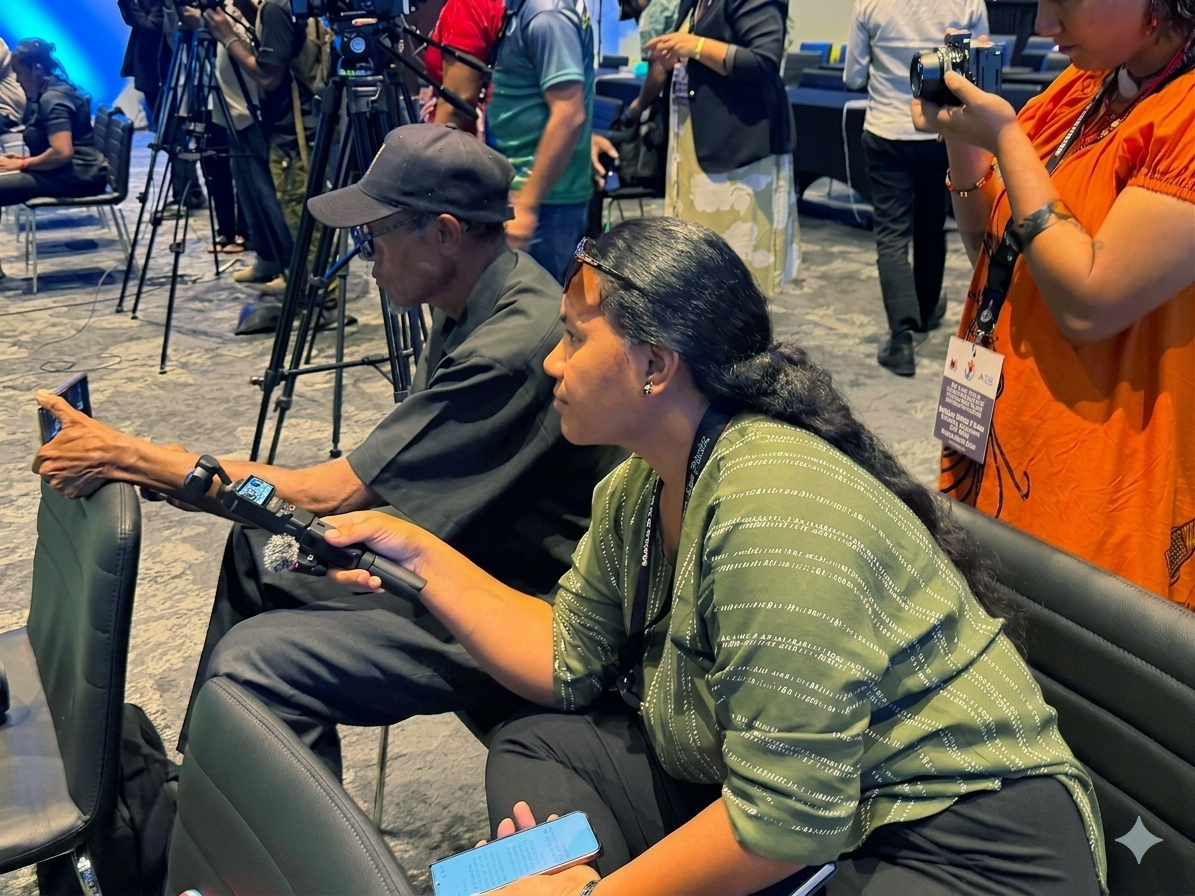
In early May, Pacific Cooperation Broadcasting Limited (PCBL), supported by The Pacific Community (SPC), carried out its Media Masterclass ahead of the sixth Pacific Regional Energy and Transport Ministers’ Meeting (PRETMM6), in Port Moresby, Papua New Guinea, training local and selected journalists from the region.
It was an opportunity for PCBL to help build capacity within the Pacific media industry, by building a connected Pacific storytelling pipeline, particularly with the Pacific Islands Forum Leaders Meeting and COP31 looming.
Tuvalu Broadcasting Coorporation journalist Jessica Tuaga and Island Times journalist Ngeldei Tulop from Palau were selected to take part in the mentoring programme, facilitated by PCBL Regional Content Manager Tia Soakai and Regional News Development Project Lead Stefan Armbruster.
Jessica Tuaga reflects on her experience:
Coming to the sixth Pacific Regional Energy and Transportation Ministers Meeting (PRETMM6) as a journalist from a small island country was both a challenge and a privilege.
For me, the journey was not just about covering a regional forum – it was about carrying the voice of my community into a space where decisions affecting our future were being made.
Before arriving at PRETMM6, I had the opportunity to attend the Papua New Guinea Media Council Summit – that experience was transformative.
The summit gathered journalists from across PNG and the wider Pacific, creating a platform to reflect on our profession’s role in shaping public discourse.
The sessions on ethical reporting, investigative techniques, and adapting to digital platforms sharpened my skills and broadened my perspective.
More importantly, the summit reminded me that journalism is not only about relaying information – it is about building trust, holding institutions accountable, and empowering communities.
The confidence I gained at the PNG Media Summit carried into PRETMM6.
Walking into the ministerial meeting, I felt prepared to navigate the technical language, the policy debates, and the diplomatic exchanges.
The summit had strengthened my ability to distill complex issues into clear narratives, and it reinforced the importance of asking sharp, relevant questions.
It gave me the courage to stand in a room full of ministers and experts and ensure that the concerns of small island nations were not overlooked.
The PRETMM6 itself was a remarkable experience. Ministers and regional leaders gathered to deliberate on energy transition, maritime safety, and transport cooperation – issues that directly affect the survival and resilience of Pacific communities.
For a journalist from a small newsroom, the scale of the event was daunting, yet, I reminded myself that my role was not to be overwhelmed but to translate these discussions into stories that mattered for families back home.
The Media Masterclass organised ahead of the meeting was another crucial step.
Divided into modules on the do’s and don’ts of covering ministerial meetings, practical guidance for reporting from regional forums, and the relevance of PRETMM6 for maritime safety and energy, the training gave us tools to navigate high‑level events.
Papua New Guinea Media Council president Neville Choi’s words resonated deeply: “Local people and audiences can only understand and connect with the stories if journalists exercise discernment.”
That insight guided me throughout the week.
As a journalist from a small island country, I felt the weight of representation.
Our challenges – rising sea levels, fragile infrastructure, limited resources – are often mentioned in passing during regional debates.
But for us, they are lived realities.
Covering PRETMM6 meant ensuring that these realities were not lost in technical jargon.
It meant connecting regional energy policies to the daily struggles of families who rely on costly diesel generators and linking maritime safety discussions to fishermen navigating unpredictable seas.
The solidarity among Pacific journalists was another highlight.
Conversations during breaks often revolved around how to make stories accessible to rural communities, how to balance accuracy with simplicity, and how to hold leaders accountable while respecting cultural values.
These exchanges reminded me that while our contexts differ, our mission is shared: to amplify the voices of our people.
The endorsement of the Pacific One Maritime Framework (POMF) was a defining moment.
Reporting on that milestone, I felt proud knowing that my coverage would help communities understand how regional cooperation could strengthen maritime safety and energy resilience.
It was proof even small countries, through shared platforms, can influence the course of regional development.
Leaving PRETMM6, I carried with me not just notes and recordings, but a renewed sense of purpose.
The PNG Media Council Summit had strengthened my skills, and PRETMM6 had tested and validated them. Together, these experiences reaffirmed that journalism from small island countries is not peripheral – it is essential.
Our stories ground regional debates in human realities.
Our voices remind leaders that policies must translate into tangible benefits for the people. And our presence at forums like PRETMM6 signals that no country is too small to matter.
For me, being part of PRETMM6 was more than professional growth; it was a journey of representation and resilience.
It was standing in a room of powerful voices and ensuring that the perspective of a small island journalist was heard, recorded, and shared.
It was proof that even from the smallest of nations, journalism can bridge the gap between regional policy and local lives.