
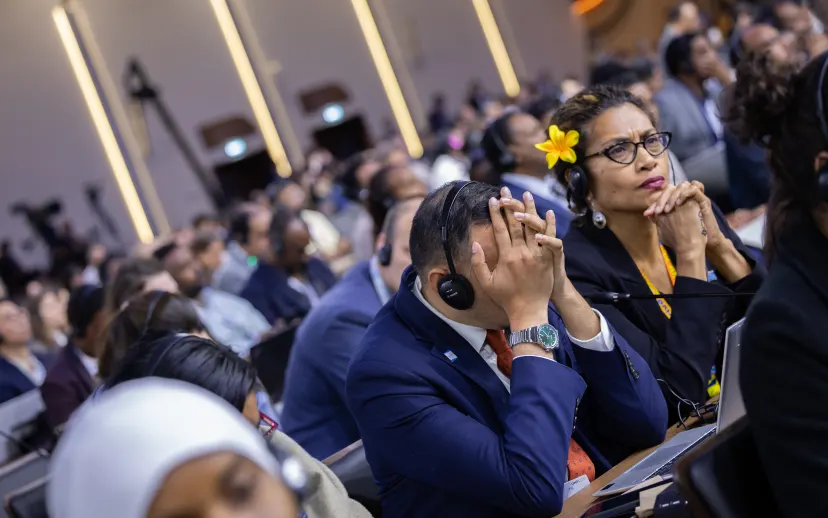
Source: RNZ Pacific
The Pacific region’s push for a stronger outcome document at the United Nations global climate talks has failed to deliver, again, following marathon last-minute negotiations that ran 48 hours into overtime in Antalya, Türkiye, over the weekend.
This year’s annual climate summit, COP31, collapsed after countries failed to reach an agreement on language regarding fossil fuels to tackle global warming.
Tuvalu’s Climate Change Minister Maina Talia told a media scrum outside the negotiating rooms after the collapse of the talks that his island nation was not happy with the state of negotiations and did not “accept the lack of ambition” at COP31.
“We will not allow inaction and obstruction to dampen our resolve or slow the progress,” he said.
UN secretary-general Antonio Guterres said he was “deeply disappointed” that the summit ended without consensus.
“I share the very profound frustration of all those who expected governments to rise to the moment the climate crisis demands,” he said.
Guterres said while there may be no consensus in the negotiating room, the science was clear.
“Temperatures keep shattering records. Climate extremes keep intensifying. Emissions remain far too high. And every delay makes our task harder and more costly.
“The world is now poised to exceed the globally-agreed limit of a 1.5 degree temperature rise. The window to keep that overshoot as short and shallow as possible is rapidly closing.
“The take-home message from COP31 is clear: the world must do much more to confront the climate crisis – and it must do it now.”
Pacific leaders and advocates had called for stronger action throughout the two-week talks after a UN report said global warming beyond 1.5 degrees Celsius above pre-industrial levels is now inevitable.
Marshall Islands President Hilda Heine warned earlier in the summit: “Every fraction of a degree we warm brings a catastrophe.”
Heine identified “fossil fuel interest” as the main cause of delayed climate action.
“Yet even as fossil fuels supplies fail and economies falter, and the financial case for renewal is clear, we still see trillions in fossil subsidies,” she said.
Fiji’s Sivendra Michael, who is the country’s climate and environment permanent secretary, said the Pacific region’s priorities had been negotiated during the Pre-COP31 meetings in Fiji and Tuvalu ahead of the Antalya summit.
“It is very draining to see our negotiators stay here till 5am. It does take a toll on our mental health as well as our physical health,” Michael told the Pacific Islands Forum as delegates were about to enter into the final hours of negotiations.
“It was very clear that the Pacific priorities are not something that [would be] renegotiated.”
Michael, who has attended every COP meeting for the past decade, said he knew that the negotiations would head into overtime.
“This is, for us, what negotiation in bad faith looks like,” he said.
“So we’ll be standing our ground and knowing that we cannot go back home and tell our people that we accepted a weak outcome.”
According to Australia’s Climate Minister Chris Bowen, there were “unbridgeable red lines” in the discussions.
Bowen, who is COP31 president of negotiations, said disagreements over fuels and climate finance were the dealbreakers.
He faced criticism from Australian opposition Senator Jane Hume on Monday.
Hume told ABC’s RN Breakfast that “[not] only has he failed in these negotiations as the lead negotiator but he’s also failed Australians at the time when he has spent AU$150m just to be there, just to get this presidency in the first place”, according to The Guardian.