Source: University of Auckland
Master navigator and carver Lamotrek Pairourou H Larry Raigetal visited the University of Auckland last week highlighting traditional navigation systems.
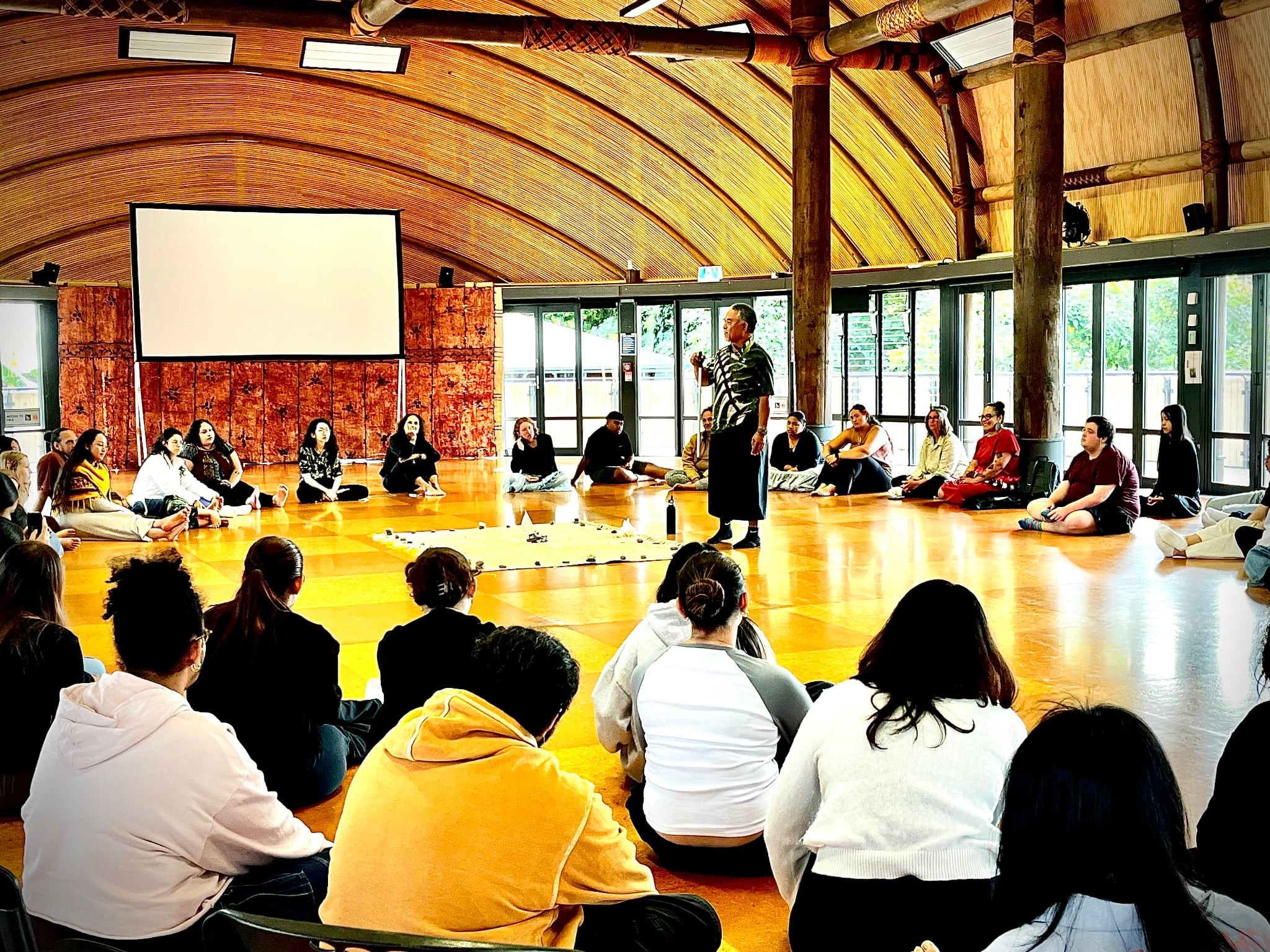
Visiting from Guam, Larry spoke with Pacific Studies’ students from Pacific Embodied Practices, about ancestral navigation traditions, ahead of a major upcoming exhibition at the New Zealand Maritime Museum Hui Te Ananui a Tangaroa.
Staged at Fale Pasifika, the session introduced Pacific navigation as an embodied Indigenous science, that understands the human body as relationally connected to the ocean, stars, environment and community.
Larry’s teachings highlight the intellectual depth and precision of western Pacific voyaging knowledge systems, which has enabled ocean travel across vast distances for generations.
The ocean-farer says he has gone around the world, to exchange dialogue with young brilliant minds, to share with them the significance of who we are as Pacific Islanders.
“We are people of the ocean, who have lived on the land for centuries,” he adds.
Larry is co‑founder of Waa‘gey, a community‑based organisation preserving traditional Micronesian technologies and arts, and addresses issues including climate change, urbanisation and economic vulnerability in remote outer islands.
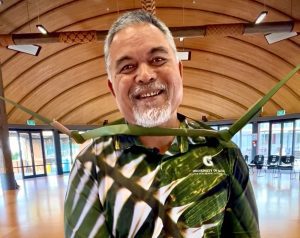
Hailing from Lamotrek Atoll in the Federated States of Micronesia (FSM), he holds talks internationally about Micronesian navigation knowledge.
Larry’s visit coincides with preparations for a major exhibition at the New Zealand Maritime Museum, opening in mid‑August 2026.
The exhibition will centre Micronesian maritime knowledge, embodied technologies and intergenerational transmission of Indigenous expertise.
“I was invited to contribute to the exhibition, I brought a sail that I had commissioned a decade ago,” Larry says.
“It’s a woven sail, that we almost lost the art and skills of weaving.
“Through the kindness of 95‑year‑old master weaver Maria Labusheilam, we were able to transfer those skills to 20 other people, who wove it.”
The large woven pandanus sail from the Lamotrek voyaging canoe Lucky Star, will be a central feature of the exhibition; Larry emphasises how master weaver Maria Labusheilam is an exemplary example of women’s leadership to sustain voyaging and weaving traditions.
Pacific Studies Professional Teaching Fellow Julia Mageau Gray, who teaches Pacific Embodied Practices at the University, says the session affirmed Pacific knowledge systems, which have long been marginalised within Western academic frameworks.
“It is incredibly important to have knowledge holders like Larry sharing how Pacific bodies are understood in relationship with the environment, the ocean and one another,” Julia says.
“What he shared shows how advanced our ancestors have always been.
“He spoke about organisations like NASA seeking validation for their own knowledge systems, while our grandmothers already knew those stars.”
She says centring Indigenous knowledge holders in universities and cultural institutions restores the authority and legitimacy of Pacific ways of knowing.
“When our knowledge holders are brought into these spaces, it raises our knowledge systems and restores the mana they deserve — not as alternatives, but as enduring and deeply intelligent sciences.”
Larry has previously served as Deputy Assistant Secretary for the Micronesian Department of Foreign Affairs, Director of the Yap State Department of Youth and Civic Affairs, and Chairman of the FSM National Banking Board.
He is currently an Assistant Professor at the University of Guam’s Micronesian Area Research Center.
His visit reflects a growing recognition across Aotearoa of Pacific Indigenous knowledge as living, contemporary and internationally significant.