
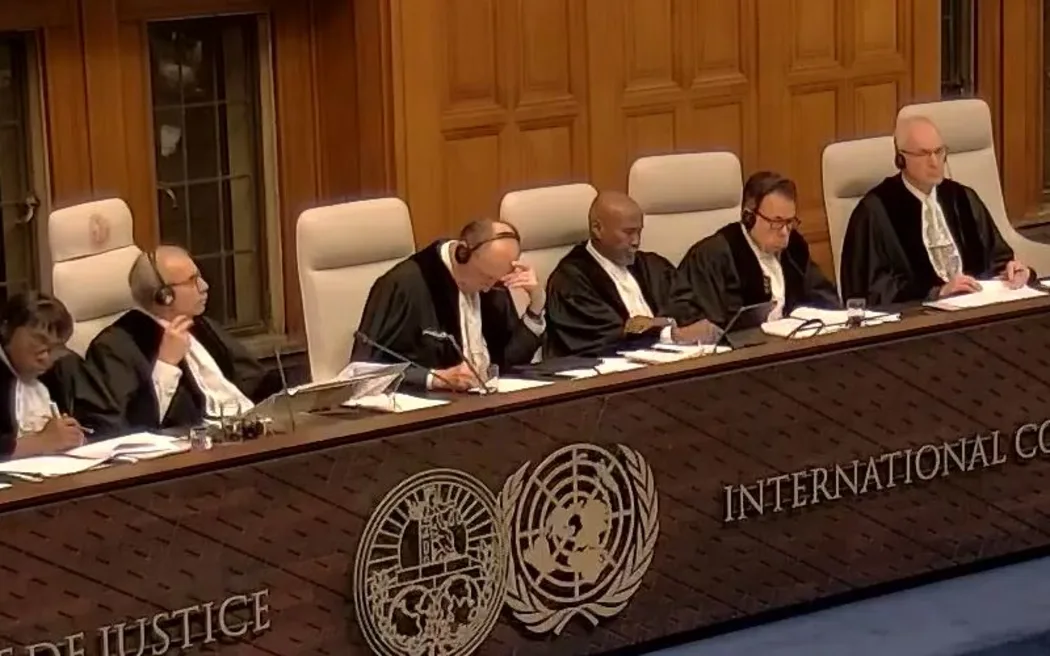
Source: Vanuatu Daily Post
The International Court of Justice (ICJ) has announced it will deliver its highly anticipated Advisory Opinion (AO) on the obligations of States in relation to climate change on Wednesday, July 23, 2025, at 3pm Central European Summer Time (CEST), during a public sitting at the Peace Palace in The Hague.
According to the Court’s official press release, Judge Iwasawa Yuji, President of the Court, will deliver the opinion during the session.
The sitting will be open to members of the diplomatic corps from participating States and international organisations involved in the proceedings, who will be seated in the Great Hall of Justice.
Representatives from non-participating States will follow the proceedings from the Small Hall of Justice.
Following the ICJ’s announcement, the Government of Vanuatu issued a statement through the Office of the Prime Minister, acknowledging the historical importance of the forthcoming opinion in advancing the global response to climate change.
Prime Minister Jotham Napat says Vanuatu is awaiting the ruling with anticipation.
“We eagerly await the landmark opinion of the world’s highest court on the greatest existential challenge facing our planet: the climate crisis,” Prime Minister Napat says.
“The AO from the ICJ, which will be issued on July 23 at 3pm CEST, is not just a legal milestone—it is a defining moment in the global climate justice movement and a beacon of hope for present and future generations.”
He says Vanuatu and its fellow Small Island Developing States (SIDS) have long warned of the growing impacts of climate change—rising sea levels, stronger storms, and the mounting cost of inaction.
Their advocacy, he adds, comes from a deep conviction that justice must prevail and that international law must protect those most at risk.
“This case was born from a spark of hope ignited by Pacific youth who dared to bring the world’s biggest challenge before the world’s highest court, and their call was supported by over 80 nations standing together for climate justice,” Prime Minister Napat says.
He referred to recent United Nations data, which recorded 152 extreme weather events in 2024 alone—a number expected to rise with accelerating climate change.
While international mechanisms such as the United Nations Framework Convention on Climate Change (UNFCCC) and the Paris Agreement have laid down foundations for action, he says they have not delivered the scale or urgency required.
“We turned to the Court to clarify what international law already requires of States, because relying solely on mechanisms like the UNFCCC and Paris Agreement is not producing the action the world urgently needs,” he says.
“We sought confirmation that States’ legal obligations extend to their climate-related actions, especially when those actions cause harm beyond their borders.”
The Prime Minister says a favourable AO could affirm States’ long-standing obligations under international law to address climate change, clarify the legal consequences of failure to act, provide courts and negotiators with stronger legal tools, improve access to finance and support for vulnerable nations, and help shift global efforts from promises to accountability.
“I am hopeful for a powerful opinion from the ICJ. It could set the world on a meaningful path to accountability and action,” he says.
Regardless of the outcome, the Prime Minister says the process had already helped raise the voices of climate-vulnerable nations, increase global awareness, and lay the groundwork for stronger future action.
“This ruling will give us a foundation to build upon and inspire continued efforts to protect our planet,” he says.
Although the ICJ’s AO is non-binding, it is expected to influence international law, climate negotiations, and cooperation well into the future.
Check the Pasifika TV schedule for hearing coverage.