
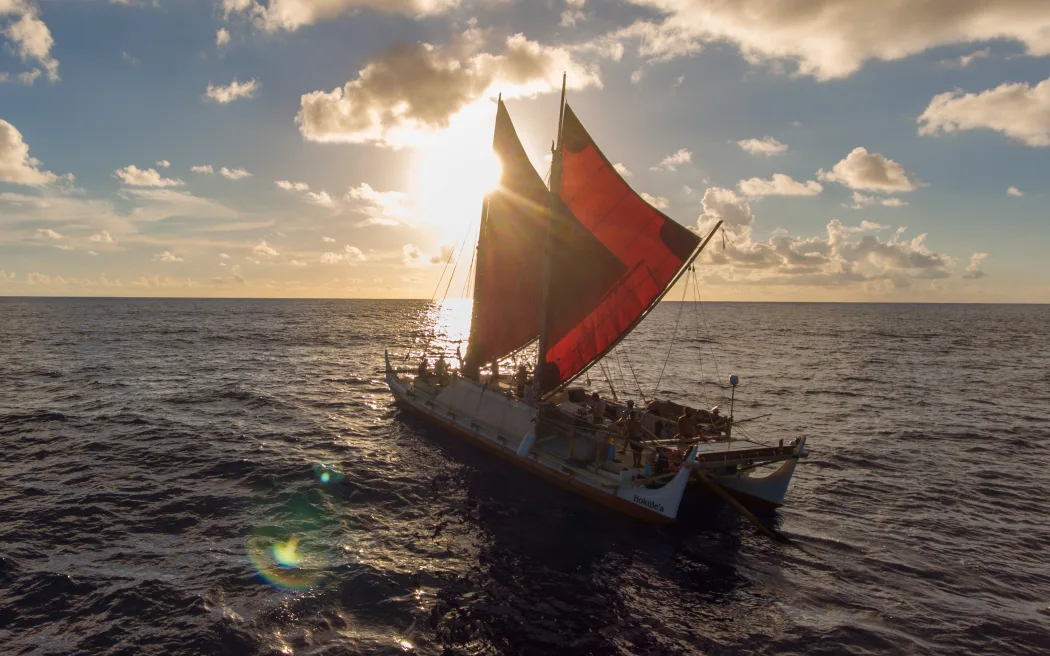
Source: Peter de Graaf/RNZ Pacific
Forty years after its first visit sparked the revival of Māori ocean voyaging, the Hawaiian waka Hōkūleʻa is due back at Waitangi tomorrow (Friday) as part of an epic four-year voyage around the Pacific.
Among those joining the crew for the last leg across the Bay of Islands will be Stan Conrad, the only Māori on board during the Hōkūleʻa’s historic 1985 journey.
Stan says it was a privilege, sailing on that maiden voyage of Hōkūleʻa, on the Voyage of Rediscovery from Rarotonga to Aotearoa.
“There were 14 crew members, but I was the only Māori boy from Aotearoa. The rest were all Hawaiian. It was amazing.”
The then 22-year-old did not realise he was helping to revive a tradition going back millennia.
A commercial fisherman at the time, he was hand-picked for the role by his elders.
“At the time it was just an adventure – I didn’t realise the huge meaning and purpose of the voyage, retracing ancestral voyages and navigating on a canoe that’s totally lashed together,” Stan says.
“That was the first time I’d ever been on any vessel that had sails.”
Since then Stan has devoted much of his life to tārai waka, the building and navigation of double-hulled ocean-going canoes, or waka hourua.
“In the beginning it was an adventure but after that voyage, that was me.
“I was hooked to continue this journey of learning about voyaging canoes and sailing, and especially navigation.”
The arrival of the Hōkūleʻa did not just change Stan’s life, it changed the trajectory of history.
Among those watching on shore at Waitangi that day in 1985 was the revered Northland kaumātua Sir James Henare.
Sir James challenged Māori to build their own ocean-going waka and make the return journey to Hawaii.
Hector Busby, later knighted as Sir Hekenukumai Puhipi, heard that challenge.
He set off to the remote Micronesian atoll of Satawal to learn the art of traditional navigation from one of the world’s only surviving practitioners, the late Mau Piailug.
He then built a series of waka, starting with Te Aurere, which have sailed not just to Hawai’i, but every side of the Polynesian Triangle.
When Hōkūleʻa and its sister vessel Hikianalia arrive on Friday, they will be escorted to shore by the great waka Ngātokimatawhaorua, just as Hōkūleʻa was during that first visit in 1985.
Ngātokimatawhaorua will be captained by Stan’s brother, Joe Conrad, who says the arrival of Hōkūleʻa in 1985 finally buried an old myth about Māori.

“We did not find these islands by accident,” Joe says.
“We knew where we were going, we knew how far and how long to get there and get back.
“It was proven that our navigators of that time knew what they were doing, knew how to find land and follow the stars, and build waka that could travel vast distances.”
Stan says he, too, was taught as a boy that Māori arrived in Aotearoa by accident.
“We weren’t people of the storm, those sort of things I was brought up to believe about our ancestors.
“The more I voyaged, the more I went on the canoe, the more I realised how amazing they were.”
Northland iwi leader Haami Piripi says the ancestors who landed in Aotearoa were among the world’s great seafarers.
“Anybody that can traverse the greatest expanse of water on the planet, by virtue of the stars, the wind and tides, has got to be pretty sophisticated,” Haami says.
He adds knowledge had been all but lost when Hōkūleʻa’s first visit, organised by Hawaii’s Polynesian Voyaging Society, reignited the desire to explore the oceans on traditional sailing craft.
“I think it really awakened an old knowledge, an old innate desire for voyaging, travelling, discovering new worlds,” he says.
“Six thousand years we’ve been in the Pacific, so we’ve been here a long time, and what tārai waka and these expeditions do is reawaken that feeling of excitement, of exploration and of achievement,” Haami says.
The ensuing four decades of voyaging had also brought the peoples of Polynesia together.
“The waka is like a needle, it sews us together as communities and initiates dialogue, contact and an ongoing relationship,” Haami says.
Stan says much had changed in the past 40 years, with as many as eight ocean-going waka hourua now based in Aotearoa.
Another waka built by Sir Hekenukumai, Ngahiraka Mai Tawhiti, had returned from a voyage to Samoa just this week.
“Now we’ve got navigation schools being created, we’re teaching the next generation and they’re picking up the voyaging,” Stan adds.
“You pinch yourself every day that, wow, we’ve done so much in that 40 years, and having Hōkūleʻa here to celebrate that, man, that’s pretty amazing.”
Hōkūleʻa and Hikianalia arrived a week earlier than expected after a 17-day crossing from Rarotonga and, after clearing Customs at Ōpua, their crews have been under tapu – or kapu in Hawaiian – ahead of their formal welcome at Waitangi on Friday.
Weather permitting, they would be welcomed onto shore and to the nearby Te Tii Marae between 3-6pm.
At dawn on Saturday, a new carving would be unveiled honouring Ngāti Ruawāhia – the title Sir James Henare gave the Hawaiians in 1985, when he declared then the sixth tribe of Te Tai Tokerau (Northland).
The ceremony would also honour the legacies of Sir James, Sir Hekenukumai, and Myron ‘Pinky’ Thompson, who led Hawaii’s ocean voyaging revival.
The waka, or wa’a in Hawaiian, will leave Waitangi on November 16 and are due at Auckland’s Maritime Museum two days later.
Nainoa Thompson, head of the Polynesian Voyaging Society and leader of the 1985 voyage, will speak at an education conference in Auckland on November 19.
Weather permitting, the waka will return north to Aurere in Doubtless Bay, where Sir Hekenukumai has built a traditional navigation school.
They are expected to remain in Aotearoa for about six months, for maintenance, educational exchanges and to wait out the cyclone season, before resuming their 80,000km Moananuiākea voyage in April.
The two waka also visited New Zealand in 2014 as part of the Mālama Honua voyage.