
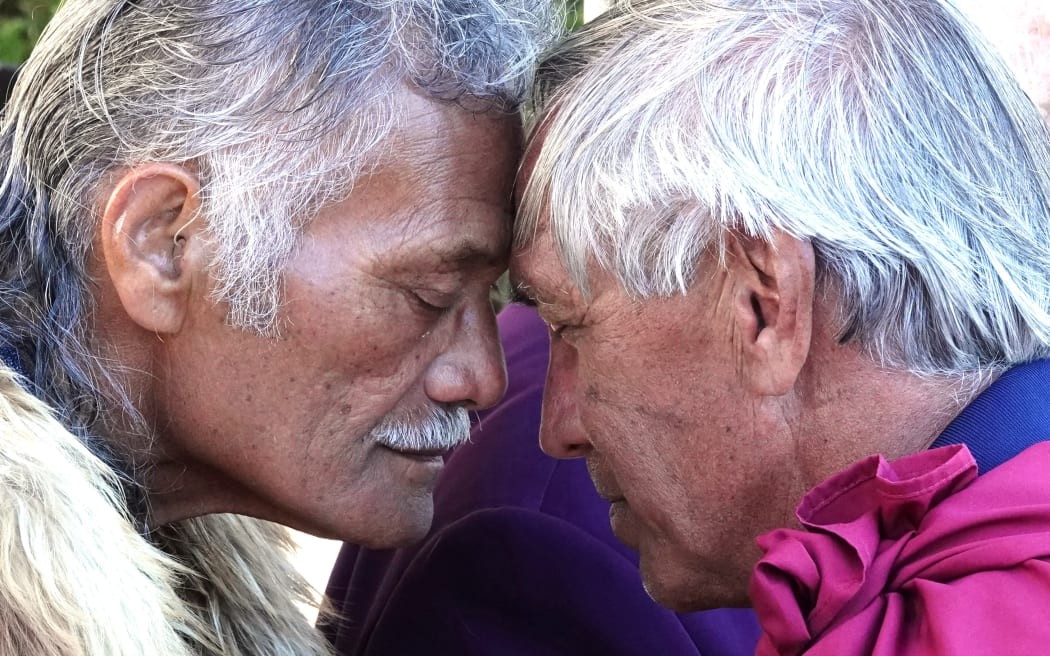
Source: by Peter de Graaf / RNZ.
A Hawaiian voyaging canoe has been welcomed back to Waitangi, 40 years after its first visit sparked the revival of ancient ocean navigation traditions in Aotearoa.
The Hōkūle’a and sister vessel Hikianalia arrived on Friday afternoon to a colourful and sometimes emotional ceremony that combined Māori and Hawaiian rituals.
Many of the more than 80 Hawaiians at Waitangi taking part in the celebrations are students from Kamehameha Schools.
The schools’ cultural director Randie Fong says the Hōkūle’a’s 1985 visit created lasting connections and strengthened cultures in both nations.
Its return is cause for great excitement – not least because, during the first visit, the late Sir James Henare, a revered Northland kaumatua, declared Hawaiians the sixth tribe of Tai Tokerau (Northland).
The Hōkūle’a’s first arrival also inspired Sir James to call on Māori to build their own ocean-going canoes and make the return journey to Hawaii.
“It’s hard to imagine the excitement that we feel,” Randie says.
“This day has been 40 years in the making.
“It’s not lost on us how significant this day is for Hawaii and also for Aotearoa.
“We always call out the significant things of this moment, which are the birth of a Hawaiian tribe, thanks to Sir James Henare, and his vision for Māori to be able to build their own waka and sail across Te Moananui-ā-Kiwa, inspired by the Hōkūle’a.”
Randie says the Hawaiian delegation isa largely made up of young people, because they would be the ones carrying on the traditions for the next 40 years.
The effects of ocean voyaging are profound, he says.
“Our people have become stronger and feel a deep sense of empowerment, both in Hawaii and here in Aotearoa.”
The two wa’a arrived off Waitangi about 2pm Friday, after a short trip across the Bay of Islands from Ōpua, where the crews had rested under kapu (tapu), after arriving almost a week ahead of schedule.
Among those on the Hōkūle’a on Friday was Northlander Stan Conrad, the only Māori crew member during the 1985 voyage from Rarotonga to Waitangi.
At the time, he was 22 years old, making him also the youngest crew member.
While on board from Ōpua to Waitangi, Conrad paid his respects to his crewmates from 40 years ago, who were no longer alive.
“It brought back a lot of memories,” he says.
“I sat there and talked with some of the young crew members, who weren’t even born when I sailed, so that was pretty special.”
The 1985 journey had been life-changing and taught him to be proud of who he was and where he came from.
Stan, who has since become a master navigator, says ocean voyaging has helped dispel myths about Māori.
“When I was brought up in school, I was taught about my ancestors being accident sailors, people of the wind, people of the storm, who didn’t know what they were doing.”
In particular, he had been haunted by a 19th century painting by Goldie, showing starving Māori arriving in New Zealand on a battered waka.
“I knew my ancestors were never like that,” he says.
The retracing of ancestral sailing routes during the past 40 years had put those myths to rest and corrected history, Stan says.
Originally, the sailors were to have been brought ashore by the great waka taua (ceremonial canoe) Ngātokimatawhaorua, but conditions were too windy in Tii Bay to safely transfer the crew between canoes.
Instead, Ngātokimatawhaorua’s 80 kaihoe (paddlers) escorted the two waka, then performed a salute to the seafarers, and a crowd of several hundred spectators gathered on shore.
The sailors were then ferried to shore on a more modern vessel, where each was draped in a kihei or ceremonial robe, and Hawaiians performed a series of chants and ceremonial dances.
Lehua Kamalu, who captained the Hōkūle’a from Rarotonga to Waitangi, says she is very familiar with the tropical oceans around her home in Hawaii.
“This trip was a huge challenge,” she says.
“This is very far south, so the air is colder, the wind is different, the way the weather moves is very different.
“We didn’t have a lot of moon or sun for many, many days, and we certainly had a lot of different wind conditions.
“It went all the way around the compass multiple times.”
However, despite the navigation challenges, the sea itself was calm, so the trip was unusually comfortable.
Lehua says it is “quite an honour” to be given the responsibility of captaining the Hōkūle’a on only its second trip from Rarotonga to Aotearoa.
During the 2014 voyage, the Hōkūle’a sailed from Tonga.
The pōwhiri or welcoming ceremony at nearby Te Tii Marae was a colourful and seamless blend of Ngāpuhi protocol and Hawaiian ritual, including hula dance and an ‘awa (kava) ceremony.
Nainoa Thompson, head of the Polynesian Voyaging Society and leader of the 1985 expedition, gave an emotional speech recalling the life-changing voyage and past teachers.
In particular, he paid tribute to Northland’s Sir Hekenukumai Busby.
Nainoa says the 16-day journey from Rarotonga to Aotearoa was not only the least known and most dangerous leg of the voyage, it was also the first time he had had to navigate on his own.
He recalls his fear and wanting to cancel the voyage, after a cyclone blew through the South Pacific, until Sir Hekenukumai told him in no uncertain terms to trust his ancestors.
Later, Nainoa told RNZ he felt honoured to be treated, not as a guest, but as family, and how remarkable it was that Sir James’ commitment to the sixth tribe still held firm 40 years later.
He says that brings responsibilities and he is looking forward to discussions in coming days about how Ngāti Ruawāhia – the name Sir James gave the Hawaiian tribe – fitted into the fabric of Māori society.
The anniversary and return visit brought back “pretty intense memories”, especially of Sir Hekenukumai, a mentor he regarded as a father.
Asked if he was proud of his part in reviving ocean voyaging, Nainoa says he is “extraordinarily grateful” to his teachers and to Māori efforts to keep the tradition alive.
“When you see Aotearoa take leadership in waka, in waka education, the number of canoes they’ve launched, it’s inspiring.
“I’m very grateful to Māori for not just keeping it alive, but strengthening it and advancing it.”
At dawn on Saturday, a new carving was unveiled on the grounds of Te Tii Marae in honour of Ngāti Ruawāhia.
Later in the morning, a 40th anniversary tribute ceremony honoured Sir James, Sir Hekenukumai and Myron ‘Pinky’ Thompson, a long-time president of the Polynesian Voyaging Society and father of Nainoa Thompson.
Hōkūle’a and Hikianalia will leave Waitangi weather permitting, and call into Mangahawea Bay on Moturua Island.
Both traditional knowledge and archaeological evidence point to Mangahawea as one of the earliest sites of Polynesian settlement in New Zealand.
The waka are due to arrive in Auckland on November 18 for a formal welcome by Ngāti Whātua Orākei.
On November 19, the waka may return north to visit the Kupe Waka Centre, created by Sir Hekenukumai at Aurere in Doubtless Bay.
Weather permitting, they are due in Aurere on November 22.
The canoes will remain in Aotearoa for about six months for maintenance and to wait out the South Pacific cyclone season.
Their visit is part of a four-year, 80,000km circumnavigation of the Pacific called the Moananuiākea Voyage.