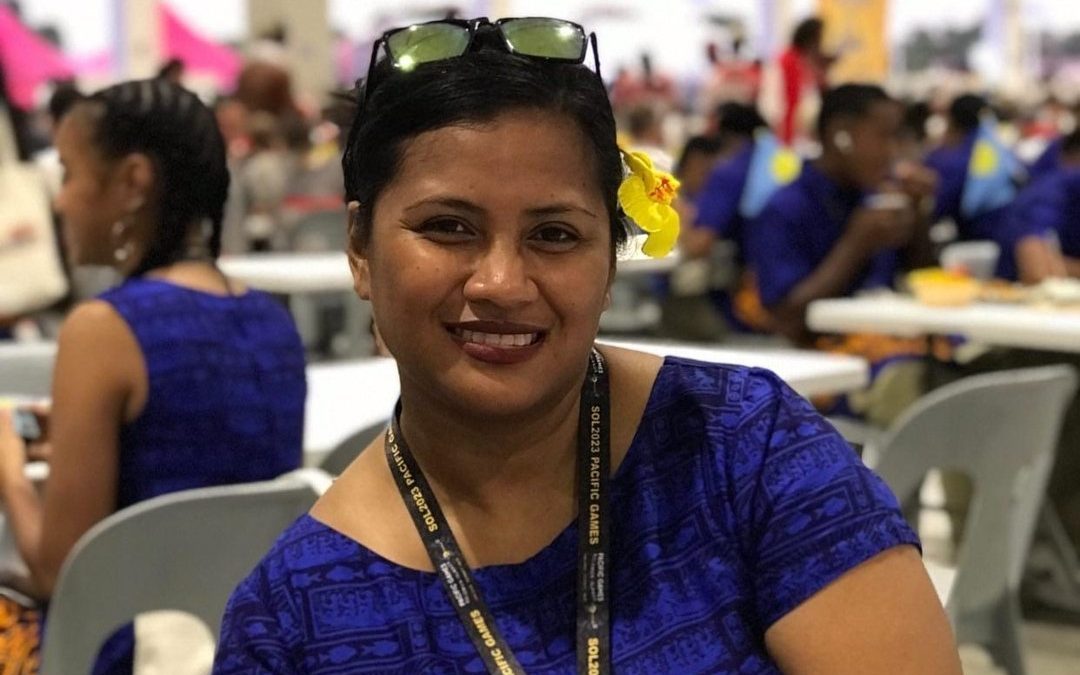

Palau’s Lincy Lee Marino says rather than replacing traditional oral storytelling of her homeland, digital technology is a much-needed vessel to move stories beyond physical spaces and reach wider audiences.
“The digital space is one that carries ancestral voices forward while adapting to contemporary ways of listening and learning,” Lincy says.
Hailing from the southernmost states of Palau – Hatohobei and Sonsorol – Lincy is a project manager for sustainable aquaculture management, where she supports environmentally responsible practices which strengthen community livelihoods.
“Deeply rooted in my culture, I am passionate about sharing and preserving the traditions, language, and identity of Hatohobei and Sonsorol for future generations,” she says.
Storytelling plays a huge part in both her job and personal ambitions, with her Palauan culture reliant on oral storytelling.
Growing up, she says her family used to tell stories that seemed humorous but always contained a moral and a lesson being passed down from one generation to the next.
“I want to continue this tradition by telling stories to preserve culture and language, honor lived experiences, and make space for voices often overlooked,” she adds.
“Through my professional work and personal commitment, I strive to uplift my community and ensure that both our pristine environment and unique culture continues to thrive.”
From March 10-13, 2026, Lincy will join 29 other Young Pacific Leaders (YPL) from 20 Pacific nations, selected to take part in the United States Department of State and Pacific Cooperation Broadcasting Limited (PCBL) hosted YPL Navigating the digital landscape workshop.
Hosted in Auckland, Tāmaki Makaurau Auckland, Aotearoa New Zealand, the workshop’s focus is on truth, transparency, and technology.
Inspired by the theme, and having never visited Aotearoa, Lincy is excited about the upcoming workshop, where she aims to gain practical tools and new perspectives on how to thoughtfully integrate digital storytelling with oral traditions while maintaining cultural integrity.
“I am especially interested in learning from other Pacific storytellers, exchanging experiences, and building relationships that extend beyond the workshop,” she says.
While one of the greatest benefits of technology is the ability to preserve and share cultural stories, language, and knowledge beyond geographic boundaries, especially for younger generations, she adds there can be a downside.
“Stories can lose context when removed from their cultural setting, and there is always a risk of misinterpretation or misuse once shared online through digital platforms.
“Not all knowledge is meant to be digitized, and navigating what should remain within the community requires care and intention.”
Ultimately, Lincy wants to strengthen her ability to tell the stories that should, and can be told.
“I hope to preserve language, amplify community voices, and engage younger generations, while being mindful of ethics, ownership, and respect for cultural knowledge.”
Storytelling can take many forms, and the high calibre of successful applicants selected from over 200 candidates for the workshop, have a variety of backgrounds, from media and communications specialists to educators, researchers, health practitioners, digital entrepreneurs and visual artists.
Cohort to attend the March workshop:
- Wallace Aroita (Cook Islands)
- Julie Cooper (Niue)
- Asia Camacho Hilario (CNMI)
- Camo Diaz Egurrola (Guåhan)
- Absalom Edwards (Marshall Islands)
- Clarriann Futai (Solomon Islands)
- Gina Ishmael (Vanuatu)
- Kreetika Kumar (Fiji)
- Gabby Langkilde (American Samoa)
- Jasmine Leota (Aotearoa New Zealand)
- Tony Leota (Samoa)
- Pita Loloma (Fiji)
- Magic Lus (Australia)
- Don Maifala (American Samoa)
- Lincy Marino (Palau)
- Michaela Montoya Gatdula (CNMI)
- Ondine Moyatea-Ferdnandez (New Caledonia)
- Dr Lavau Nalu (PNG)
- Jay Nasilasila (Fiji)
- Chelsea Pedro (Palau)
- Rain Sancher (FSM)
- Antonnia Singut (PNG)
- Penina Sua-loa (Samoa)
- Maria Tanner (Cook Islands)
- Tahnee Tchen (French Polynesia
- Esther Tetava (Cook Islands
- Pohaikealoha Worley (Hawai’i)
- Gitty Yee (Tuvalu)
- Kanoelani Toshida (Hawai’i)
Visit the Young Pacific Leaders website for more information about the US Department of State program.