
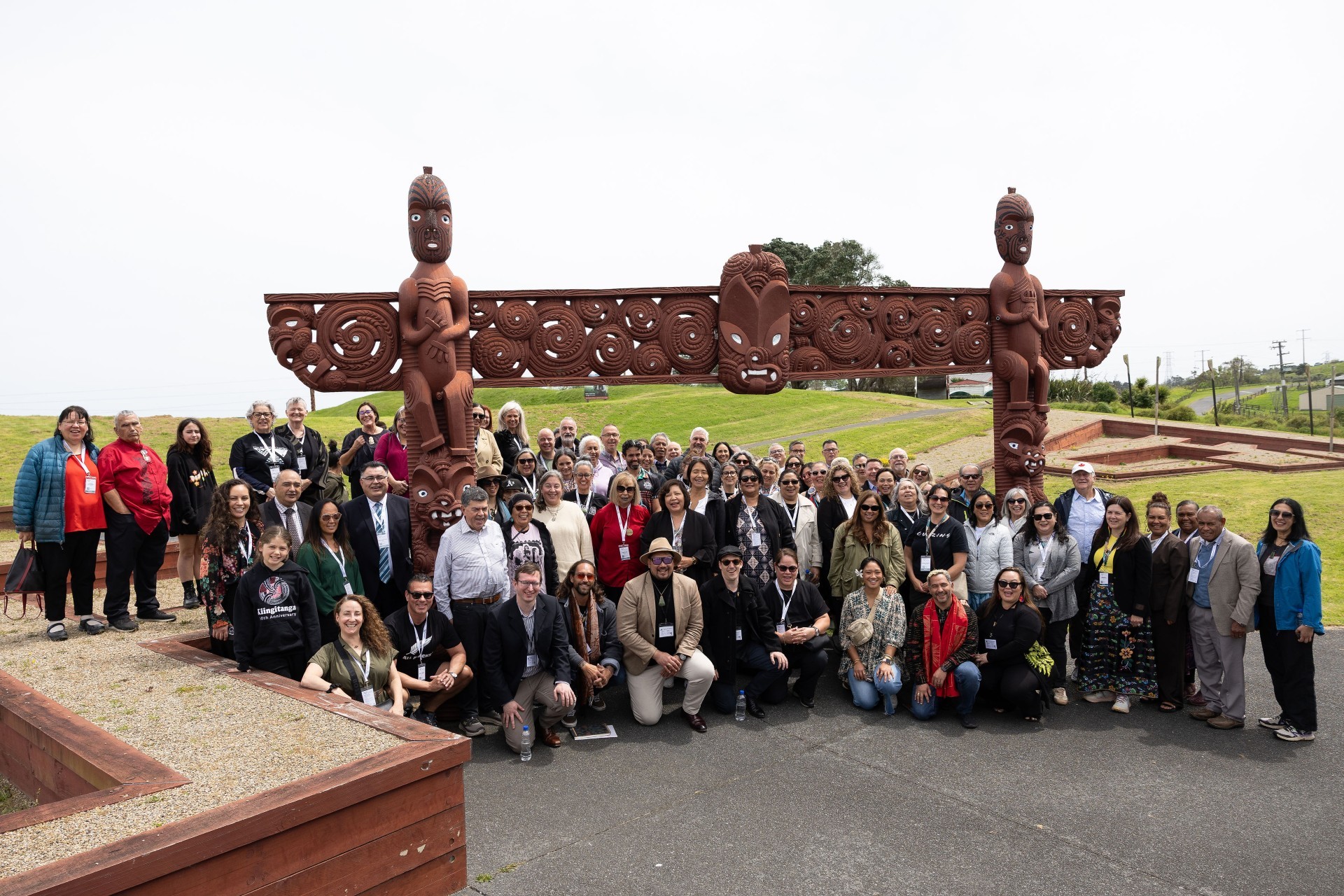
Editorial by Kai Lawrence
(Hawai’i-based lawyer/Board member of the Native Hawaiian Bar Association)
“Mehemea ka moemoeā ahau, ko ahau anake.
Mehemea ka moemoeā tātou, ka taea e tātou.”
“If I dream, I dream alone.
If we all dream together, then we shall achieve.”
-Te Puea Hērangi (Influential Māori Leader)
During the last week of October 2025, indigenous lawyers and judges from around the world descended upon Aotearoa (New Zealand) for the inaugural World Indigenous Lawyers and Judges Conference.
Conference speakers from around the globe emphasised the need for indigenous voices and culture within the legal systems of the world, while also speaking to the theme of the event – “tuia ki te muka tāngata,” meaning “bound together by our indigeneity”.
First Nations at the summit were indeed ‘bound together’ as attendance included more than 400 indigenous lawyers and judges representing Aotearoa, Australia, the US (tribal nations and Native Hawaiians), Canada, and several other Pacific islands.
This conference – the first of its kind – was a formal gathering of indigenous, legal professionals meeting to discuss shared challenges, to understand how incorporating culture, ancestry, and connection-to-land can result in better legal outcomes for the system itself, and to build a coalition focusing on best practices and shared ‘ike (knowledge) in law.
The event opened with the Pōwhiri, a traditional Māori welcome, at Tuurangawaewae Marae near Kirikiriroa (Hamilton), Aotearoa.
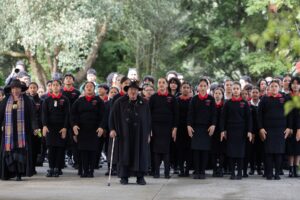
Attendees were awestruck as they were greeted by a host of Māori, both young and old, dressed in elegance in the traditional black and red of Aotearoa, many faces highlighted by Tā Moko, or the traditional Māori face tattoo, as they welcomed the incoming nations in song, chant, and prayer.
The young Māori queen was in attendance as well, dressed all in black, with stylish black shades and her traditional Tā Moko.
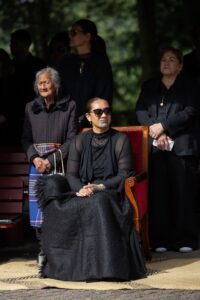
Judge Joe Williams of Aotearoa, speaking at the Pōwhiri, hoped the conference would “fulfill the longing for kindred experience” that indigenous people feel in an overwhelmingly western world.
Tai Ahu, the then-president of the Māori Law Society, in an interview after, said the event was “an exercise in excavation, building, learning, and connection.”
Speaking to the need for indigenous voices and culture in law, the Honorable Dame Helen Winkelmann, Chief Justice of Aotearoa, stated at the opening ceremony that “at times, the law has been an engine of injustice for Māori.”
Dr. Vincent Omalley echoed this, noting the travesties of land theft, war, murder, and forced assimilation that occurred during the colonization era of the 1800’s.
Attendees at the conference felt the gravity of this history as, following the Pōwhiri, they toured the nearby Rangiriri Pa’a, a historic battle memorial where, in 1863, during the Waikato Wars, 300 Māori fighters, fighting to defend home and family, held out for days against 900 of the world’s most elite army – the British.
The tour docent, a member the Queen’s retinue, concluded by directing attention to the nearby lake, asking us to imagine and hold reverence for “the more than 120 women and children who now lie at the bottom of that lake”.
During the conference, the need was again highlighted as Michelle O’bonswain, Court Justice of Canada noted that the Truth and Reconciliation Commission of Canada found “the goal of colonialism was to erase indigenous peoples completely”.
The trauma of these tragic histories has played out in the court systems of today.
For example, indigenous persons in Canada represent only five percent of the population, yet they account for more than one-third of the prison population, while also experiencing higher incarceration rates and receiving bail at lower rates than non-indigenous.
In Aotearoa, Māori account for 17 percent of the population but make up more than 50 percent of the prison population.
In Hawai`i, the story is the same – the 20 percent Hawaiian population accounts for 40 percent in prison.
The same statistics are true for Aboriginal peoples in Australia as well.
So, what can be done? How can different outcomes be achieved? And will this lead to better results not just for indigenous persons but for the system itself?
Speakers at the conference noted that incorporating culture and ceremony into the legal system is crucial.
Judge Jesse Hall of Hawai`i, noted studies have shown indigenous persons who are connected with culture in the legal system end up having less interaction with the judicial system going forward.
This results in less stress on the system itself, which in turn translates to economic savings and resources being better spent outside the system.
In Aotearoa, cultural courts have been established, connecting Māori offenders to the Marae, involving Tupuna (elders) in the process, and ensuring Te Reo (the Māori language) is spoken.
Judge Aiden Warren of Aotearoa, one of the key organizers of the event, said “if the system is going to work, persons need to be able to see themselves represented therein; they need to feel like at least the system understands them and where they are coming from”.
This approach has worked in Aotearoa, resulting in less recidivism, and is being replicated in nations throughout Pasifika.
In Hawai`i, small steps on this path arrive as the Hawai`i Supreme Court recently began opening each session in ʻŌlelo (Hawaiian language), and as the judiciary has changed its judiciary letterhead to feature ʻŌlelo alongside English.
This matters as language is the key to accessing culture.
Hawaiians are no stranger to this fact as, following the illegal and US-government-backed overthrow of the peaceful Hawaiian kingdom in 1893, not only was hula banned, but so too was ʻŌlelo.
Hawaiian children in school were punished for speaking their native language.
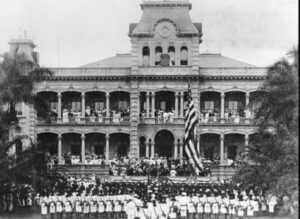
Indeed, ʻŌlelo was almost lost until the cultural renaissance of the 1970’s.
Now, ʻŌlelo is taught in schools across the State, and immersion schools are common as well, noting that the State Constitution of 1987 includes both ʻŌlelo and English as the State languages.
Judge Hall, in an interview after the event, noted that more is needed in Hawai`i as she is in the process of attempting to organize the first cultural court for youth offenders.
Other speakers at the event touched further on the significant impact of culturally-attuned courts.
Where a western-approach often only allows for the limited options of jail or probation in sentencing, cultural courts, and/or the incorporation of cultural sentencing guidelines, allow for options that seek to address and heal the harm rather than just punish, including connecting the offender to culture and offering opportunities to perform service within the communities affected.
These outcomes result in rehabilitation, not just retribution.
Allyship was a key theme of the conference as well.
Eru Kapa-Kingi, a key organizer of the 2024 Hīkoi march, a march of thousands of Māori in protest of conservative legislation aimed at dismantling Māori organizations/rights, spoke as part of the panel on “Advocacy in Challenging Times”.
He noted though the protest march was bitterly fought and highly charged, a key factor in the march’s success was its targeted messaging focused on peace and on seeking allies across all peoples.
He also stated Māori need to “embrace their oppressor” and this is what is required of “tangata whenua” or the people of the land.
Robin Kimmerer, Native American writer and botanist, in her book Braiding Sweetgrass, said at one point all peoples were indigenous to somewhere, having the same connection to land and to ceremony that was expressed at the conference.
This principle is echoed in Hawai`i as well where the principles of Aloha and Aloha ‘Āina require respect, protection, and love for the land and for all people who reside thereon, even the oppressor.
Hawaiians have faced this challenge repeatedly and will continue to do so as their culture is under threat once again via recent lawsuits from various conservative groups targeting cultural programs and institutions meant to benefit Hawaiians.
In October 2025, the Students for Fair Admissions organization filed suit against Kamehameha Schools – a privately endowed school built specifically for the benefit of underserved Hawaiians and the perpetuation of culture – claiming the school’s admission process, which allows preference for students of Hawaiian descent, violates the Constitution.
Hawaiian Senator Keohokalolo said the suit was being brought by “tone deaf outsiders who know nothing about Hawai’i”.
In June 2026, a lawsuit was brought by a non-Hawaiian against the Hawaiian Homes Commission, arguing the requirement of Hawaiian ancestry in order to receive a homestead lease on Hawaiian Homelands is unconstitutional.
This directly threatens the Hawaiian Homes Commission Act of 1921 which set aside roughly 200,000 acres of land for Hawaiians as a way to reconnect Hawaiians to the land they lost via the atrocities of colonialism.
In March 2026, a lawsuit was filed challenging a decades-old scholarship program that provides financial assistance to Hawaiian students pursuing health careers in exchange for serving in marginalized Hawaiian communities.
Hawaiians hope the continued challenges will at least galvanise unity among Hawaiians and increase allyship as the struggle continues.
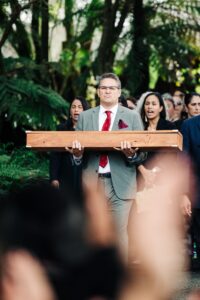
As the conference closed, gifts were given from the various visiting nations to the Māori Queen.
Gifts included items as a hawk feather, a cedar plank, seal mittens, and woven fabric, symbolising the need for indigenous peoples to be protectors of one another and of the land, of the need for unity, and of the prospect of a better future, not just for those who are indigenous but for all.
The most significant offering at the conference was the presentation of an exquisitely crafted hoe, or paddle, symbolising the wa’a, or canoe, that is our mother earth.
The paddle is significant because none are exempt – black, white, indigenous, other – if you are in the wa’a, then you must help paddle forward.
Just as the Pōwhiri opened with song, chant, and prayer, so too did the closing, as the conclusion of the conference saw the next step for the coalition.
Judge Warren, speaking after, noted that the judges in attendance, following the closing, met together to officially form the World Assembly of Indigenous Judges – a coalition focused on making sure the indigenous voice is not silenced.
As Eru Kapa-Kingi said, we of indigenous blood need to “manifest our future” – we need to believe in it.
This conference, the first of its kind, was a step in that direction. Whether this new coalition can indeed hold that line remains to be seen.
But if the Conference proved anything, it is that the “kindred experience” Judge Williams spoke of is real, and it now spans oceans.
As Te Puea Hērangi’s words remind us—dreamed alone, an aspiration goes only so far, but dreamed together, across Aotearoa, Hawai`i, the US, Canada, Australia, and beyond, it becomes something closer to reality.