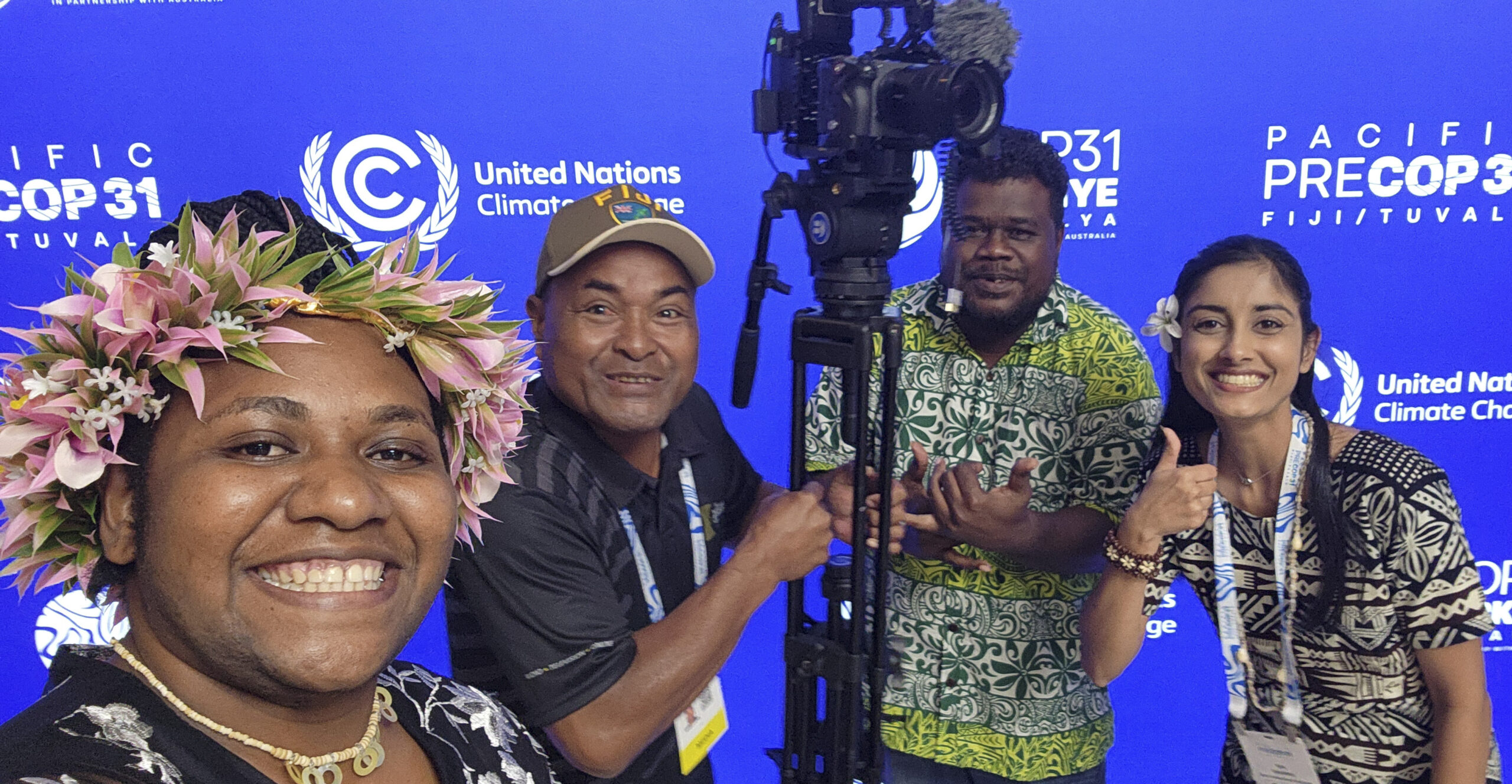
Four Pacific media professionals recently explored the workings of international meetings at Pre-COP in Fiji and Tuvalu, and how to relay important key messages back to their island communities.
With the impacts of climate change directly affecting Pacific communities throughout the region, and the Pre-COP being hosted by Australia, in the region, this was a unique opportunity for the four individuals selected to complete the Pacific Cooperation Broadcasting Limited (PCBL) and Secretariat of the Pacific Regional Environment Programme (SPREP) Pre-COP and COP31 Media Programme.
The Pacific cohort, consisting of Papua New Guinea’s Varia Pekuku Omoa from EM TV and Wari Ila from National Broadcasting Corporation (NBC), Solomon Islands Broadcasting Corporation (SIBC) reporter Alex Dadamu, and Riya Bhagwan from Fijian Broadcasting Corporation (FBC), collectively covered important issues throughout Pacific Climate Change Week, followed by Pre-COP, supported by Pasifika TV’s Regional Content Manager Tia Soakai.
Using insights and learnings from Pre-COP, the Pacific cohort will now focus on delivering regionally focused stories from the UNFCCC 31st Conference of the Parties (COP31) in Antalya, Türkiye from November 9-20, 2026.
Below, the Pacific cohort share their highlights from Pre-COP as well as their greatest takeaway from the event.
Alex Dadamu (Journalist – SIBC TV)
Reporting at the Pacific Pre-COP31 has been a big and rewarding experience, and a major step in my humble journey in journalism. My biggest highlight was being part of a regional media team with Pasifika TV and covering important conversations on climate change that affect our Pacific region.
As a first timer at an event of this size, my biggest learning has been how to keep up with the fast pace, find the right stories and adapt to the demands of regional reporting. I’ve spent the past few days finding my rhythm, learning as I go and pushing myself beyond my comfort zone. Also, being in front of the camera and learning to think on my feet is also my other biggest learning experience.
Ahead of COP31 in Antalya, Turkey, one thing I want to work on is building my confidence, especially when asking questions and delivering stories under pressure. I’m grateful for the experience.
Varia Pekuku Omoa (Camera operator – EM TV)
One of my biggest highlights was being part of my first international work assignment and meeting other Pacific media professionals while capturing stories about the climate challenges affecting our region. My biggest learning was understanding how important strong visuals, interviews and storytelling are in helping people connect with climate issues.
As a camera operator who is also learning and gaining experience in editing, I hope to continue improving my editing and storytelling skills ahead of COP31 so I can contribute to telling more impactful stories and sharing the voices of communities in Papua New Guinea and across the Pacific.
Riya Bhagwan (Journalist – FBC)
One of my biggest highlights was witnessing the resilience of Pacific people, who, despite decades of fighting for climate action, continue to push for the same priorities with the same determination and passion. There is a strength in the region’s refusal to give up, even when progress has been slow, and the stakes continue to rise.
My biggest learning was the importance of strong coordination, preparation and collaboration when covering a major international event with multiple moving parts. Ahead of COP31, I want to focus on better team coordination and planning so we can work more efficiently, make the most of our time and deliver stronger, more comprehensive coverage.
Wari Ila (Cameraman and editor, NBC)
My participation at Pre-COP31 in Nadi, Fiji, strengthened my commitment to Pacific storytelling and climate advocacy. Through Pasifika TV, I contributed to bringing the Pacific’s voices, lived experiences, and urgent climate concerns to the forefront—particularly the fight to keep the 1.5 degrees Celsius target alive and ensure fair, accessible climate finance for climate-vulnerable Pacific nations.
Our stories are our power. By delivering impactful, people-centred content across the Pacific, we help ensure our communities are not merely subjects of climate change, but voices shaping the regional and global response. The Pacific must be seen, heard, and represented in every conversation that determines our future.