Source: Ednal Palmer of InDepth Solomons, the Pacific Media Team coordinated by SPREP funded by the New Zealand Government.
Pacific nations have closed a week of landmark climate talks in Apia, Samoa, with a united call for increased global support and decisive regional action to address the escalating impacts of climate change.
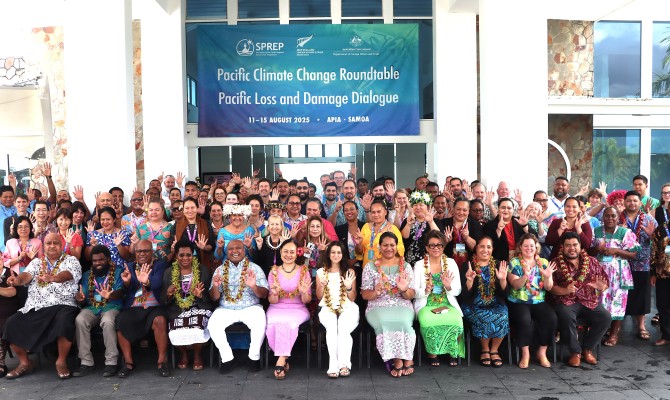
The back-to-back gatherings—inaugural Youth Dialogue on Loss and Damage ( August 7-8, 2025), the Second Pacific Regional Dialogue on Climate Loss and Damage (August 11-12, 2025) and the Pacific Climate Change Roundtable (August 13-15, 2025)—were hosted by the Secretariat of the Pacific Regional Environment Programme (SPREP) and brought together government leaders, technical experts, civil society representatives, and international development partners.
These meetings marked a critical moment in the Pacific’s climate response, offering a platform to exchange knowledge, coordinate strategies, and strengthen the region’s collective voice in global climate negotiations.
Dialogue focused on urgent measures to address climate-related loss and damage, while the Roundtable expanded discussions to encompass adaptation, resilience-building, and sustainable development pathways.
Call to take the message to higher-level discussions
While closing the weeklong event, SPREP Director General Sefanaia Nawadra urged delegates to ensure outcomes from the meetings are carried into high-level forums.
“We leave this meeting with a clear understanding of our action plans moving forward,” Sefanaia says.
“Let us return home and reflect on what we discussed and consider how—both individually and collectively—we will take these plans forward.
“We must also bring our key messages to major upcoming gatherings, including the United Nations Environment Programme (UNEP) meeting and the Pacific Islands Forum Leaders’ Meeting.
“I hope you find the discussions useful and that they inspire ideas we can incorporate into the broader climate change architecture moving forward.”
Financing at the forefront
The Roundtable concluded with a dedicated session on climate finance, where delegates and development partners jointly called for stronger, more predictable funding streams to help Pacific communities both withstand and recover from climate shocks.
Recognising the urgent need for resources to implement loss and damage measures, participants urged for direct access to finance, simplified application processes, and increased flexibility to meet local realities.
Tagaloa Cooper, SPREP Director of Climate Change Resilience, says Pacific communities are already living with the reality of loss and damage every day.
“This is not a distant threat—it’s our present,” Tagaloa says.
“We have the expertise and commitment here in the region, but to turn plans into action, we need fair and sustained financial support from the global community.”
Commitments to action
During the talks, delegates reaffirmed their commitment to strengthen regional coordination on loss and damage response mechanisms, advocate for Pacific priorities in international climate negotiations and scale up adaptation measures that protect livelihoods, ecosystems, and cultural heritage.
They also commit to leveraging traditional knowledge alongside science-based solutions and secure long-term climate finance to sustain community resilience and recovery.
Development partners have echoed the urgency of these priorities, with several pledging to align their support more closely with Pacific-led strategies.
A unified regional voice
The Apia meetings demonstrate the Pacific’s growing resolve to lead on climate action despite contributing the least to global greenhouse gas emissions.
As discussions closed, delegates have stressed the outcomes of both the Dialogues and the Roundtable will directly feed into preparations for upcoming international climate conferences, ensuring the Pacific’s voice is heard on the world stage.
Chris Teva of the Solomon Islands says this is more than a call for help—it’s a call for partnership.
“We are not passive victims; we are active leaders, but leadership must be met with solidarity and resources if we are to secure a future where our islands can thrive.”
The week’s proceedings ended with a shared commitment: to transform words into tangible, on-the-ground action that strengthens Pacific resilience today and safeguards the region for generations to come.
The first Pacific Editor’s Talanoa on Loss and Damage was filmed in Apia, made possible by TV1 Samoa and Pasifika TV, who partnered with SPREP.
You can watch the talanoa HERE, or check the Pasifika TV website for an updated schedule.